Week 0️⃣ 8️⃣
The -LING Suffix
🔊 Audio
📜 Show transcript
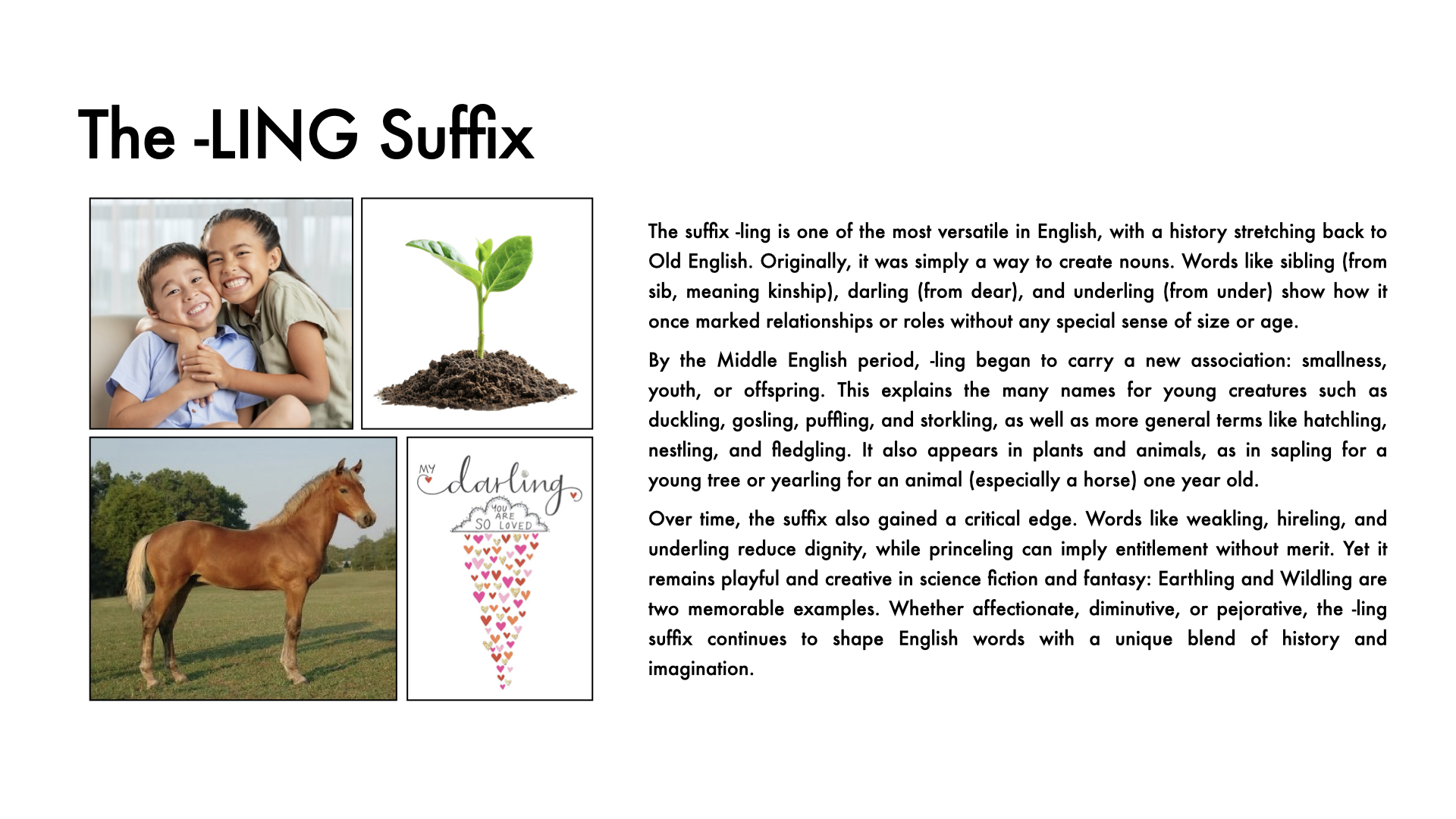
The suffix -ling in English has a long and interesting history. In Old English, it was simply a way to form nouns. The word sib meant kinship, and from this came sibling, a relative. From dear we got darling, a beloved person. From under came underling, literally someone beneath another in rank. At this stage, -ling didn’t necessarily mean small or young; it just created a noun.
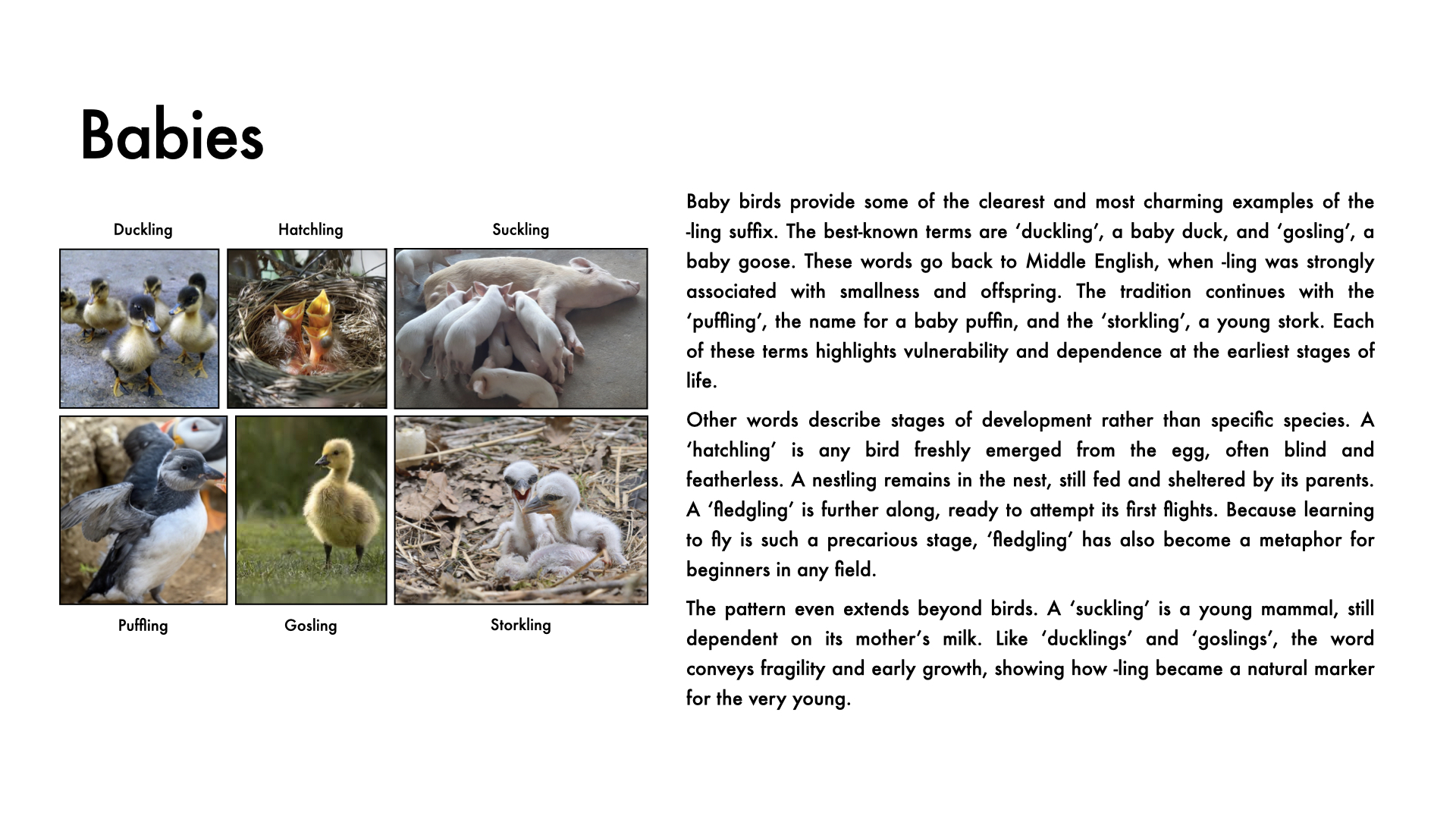
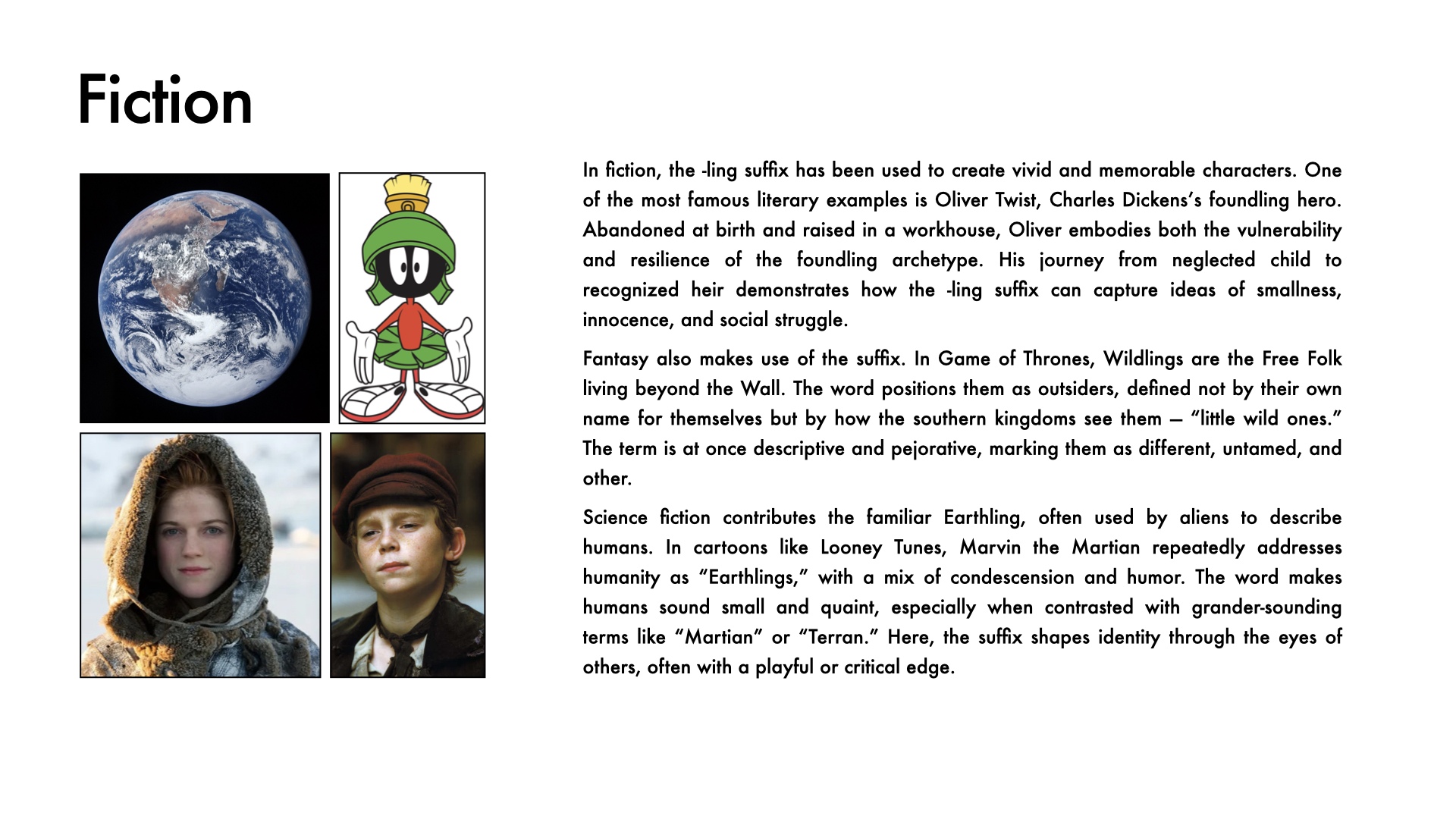
In Middle English, the suffix developed new associations. It began to mark smallness, youth, or the sense of offspring. This is especially clear in the names for young birds. A duckling is a baby duck, and a gosling is a baby goose. A hatchling is any bird newly out of the egg, while a nestling is one still confined to the nest. A fledgling is a bird just learning to fly, and the word is also used more broadly for a beginner in any field. More specific examples include a puffling, the name for a baby puffin, and a storkling, the name for a young stork. These examples show how strongly the -ling ending became linked with the idea of smallness and youth. Sapling, from an older sense of sap meaning “plant,” came to mean a young tree. Yearling describes an animal one year old. A foundling is an abandoned infant discovered and cared for by others, a figure that appears in myth, religion, and literature from Moses to Oliver Twist.
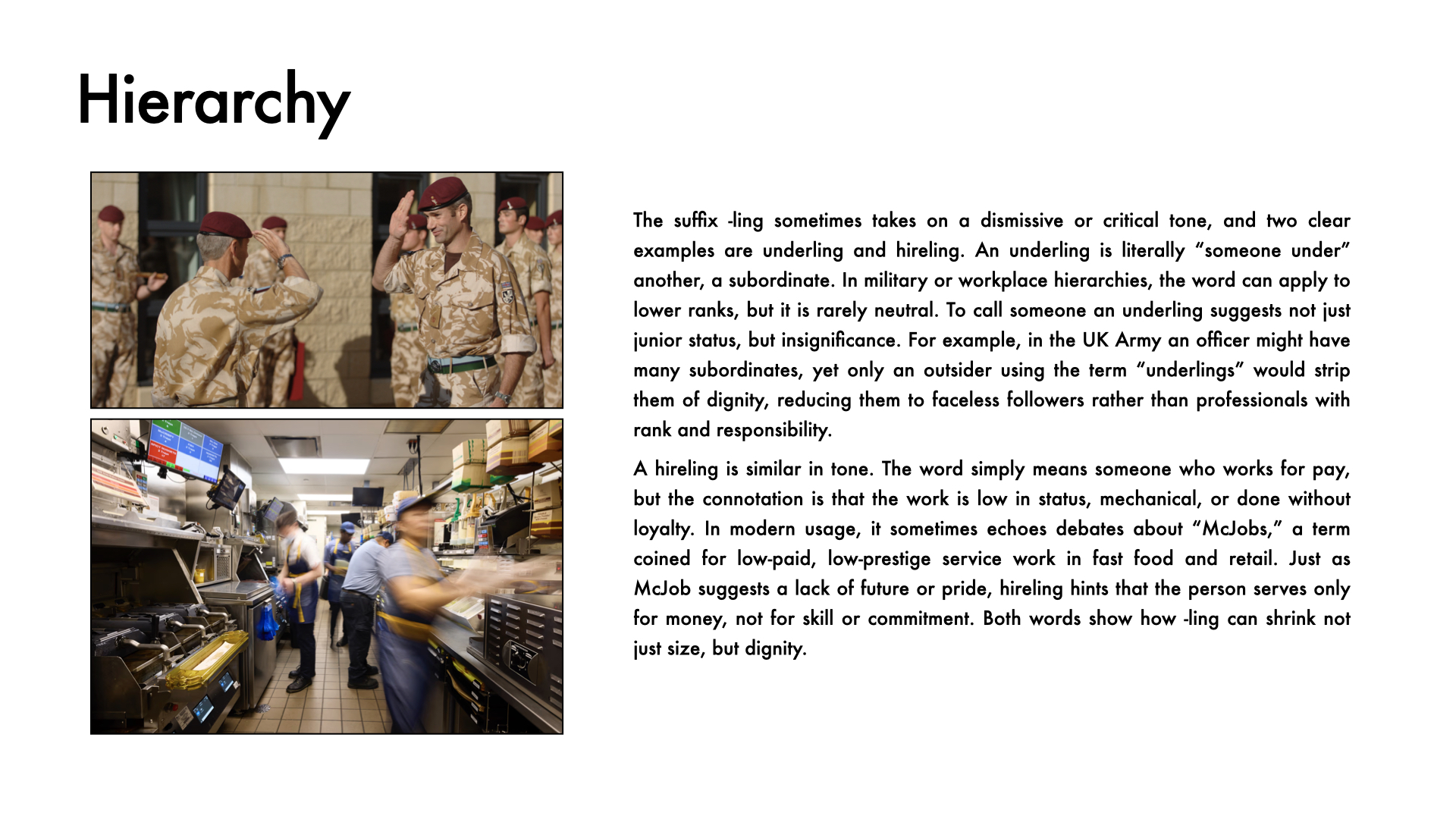
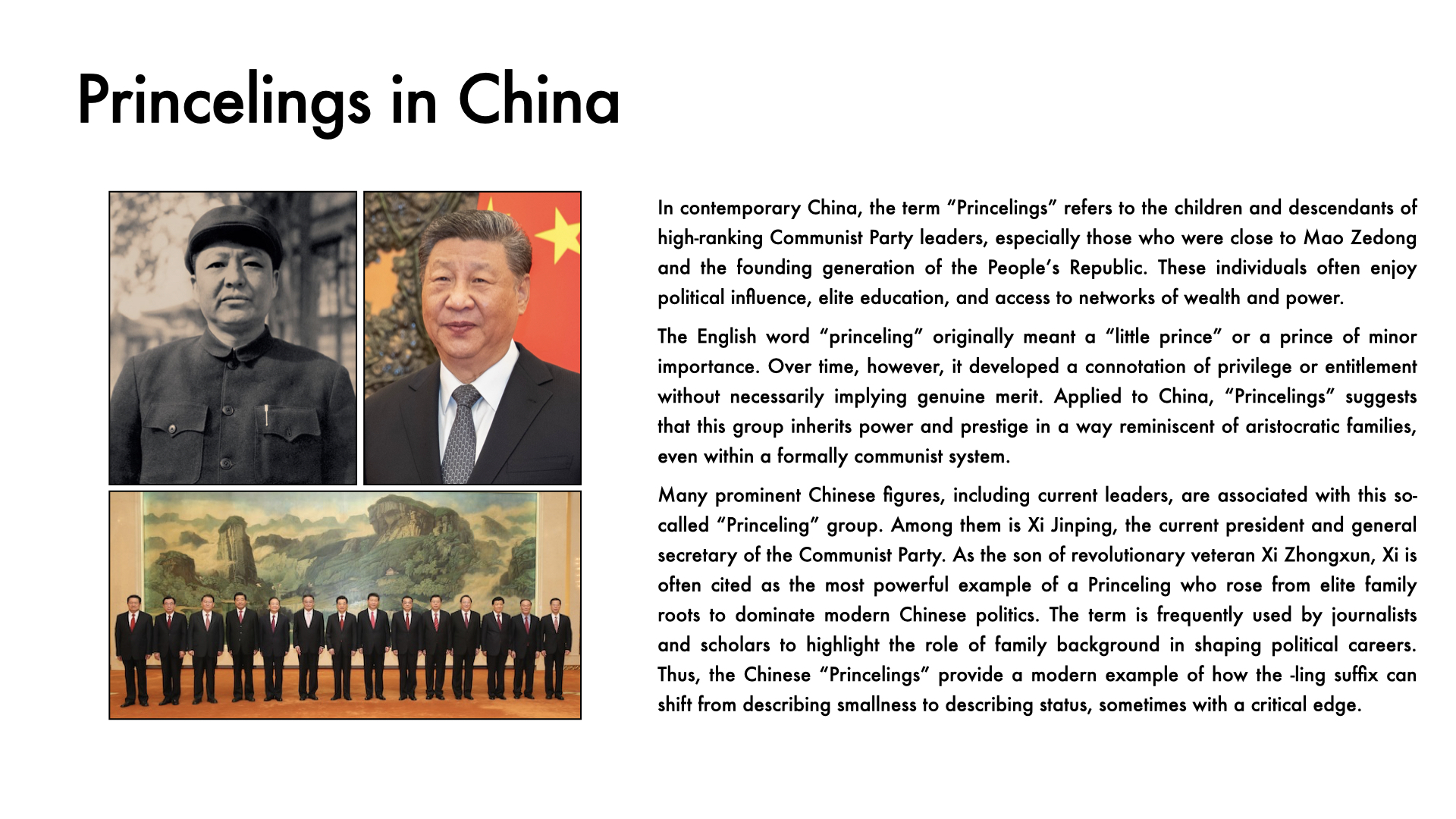
The suffix also appears in negative or critical forms. A weakling is a frail person, usually an insult. A hireling is someone who works for pay, with a hint of low status or questionable loyalty. A princeling is a minor prince or the privileged child of leaders, often used with sarcasm. In China, the term Princelings refers to the descendants of senior Communist Party leaders who themselves have risen to high-ranking positions. A changeling comes from folklore, a child swapped by fairies. These uses show how -ling could move from neutral to pejorative meanings.
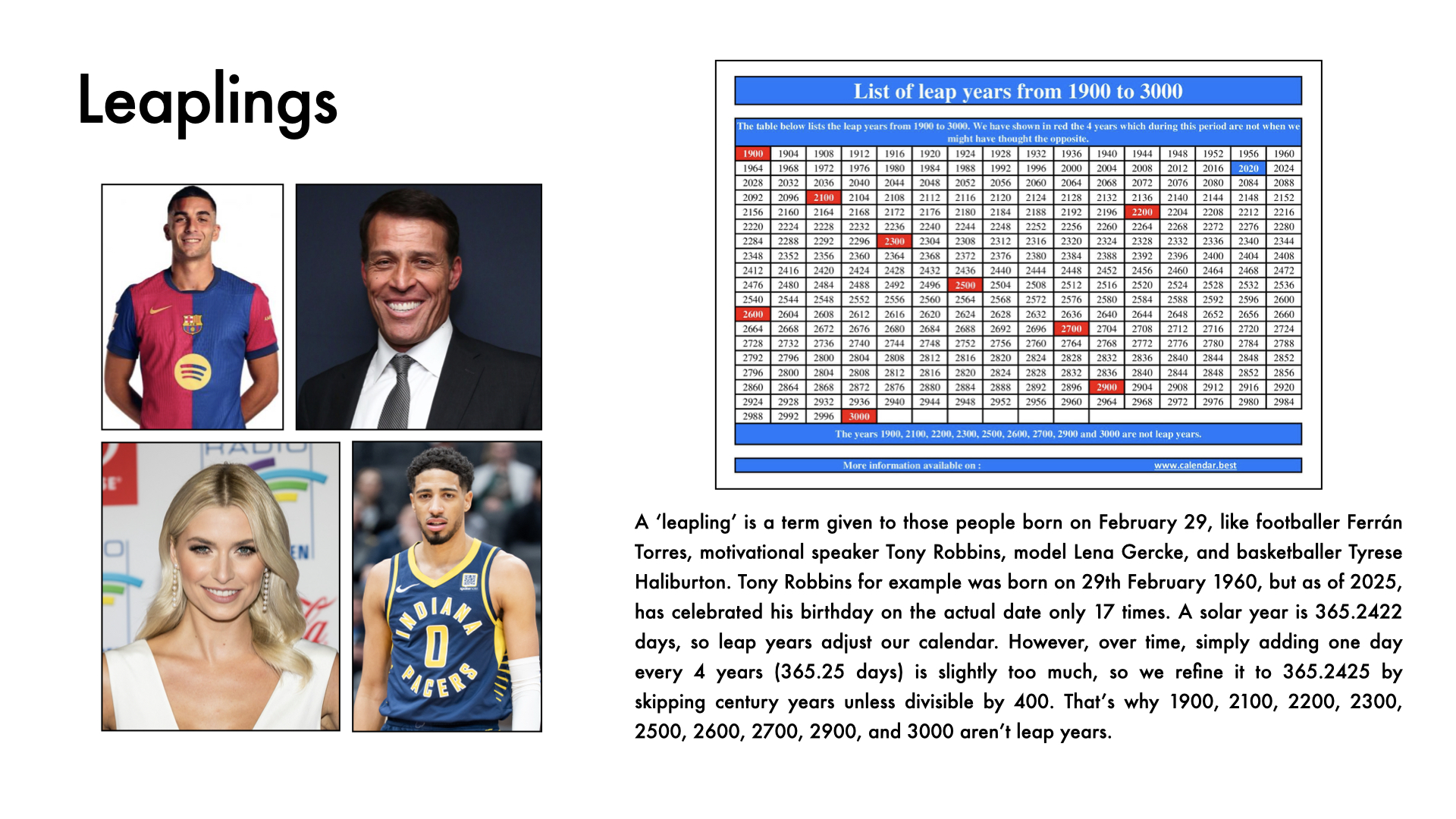
Writers have also used -ling for playful or imaginative coinages. Earthling is a familiar science-fiction word for a human being, often contrasted with aliens. But notice that the usual word for someone from Mars is not Marsling, but Martian, which comes from Latin. Still, it would be easy to imagine a Moonling, a being from the Moon, if writers chose to invent such words. Wildling was popularized by the Game of Thrones series to describe outsider tribes. A leapling is someone born on the twenty-ninth of February in a leap year. These examples show how the suffix remains open to creativity.
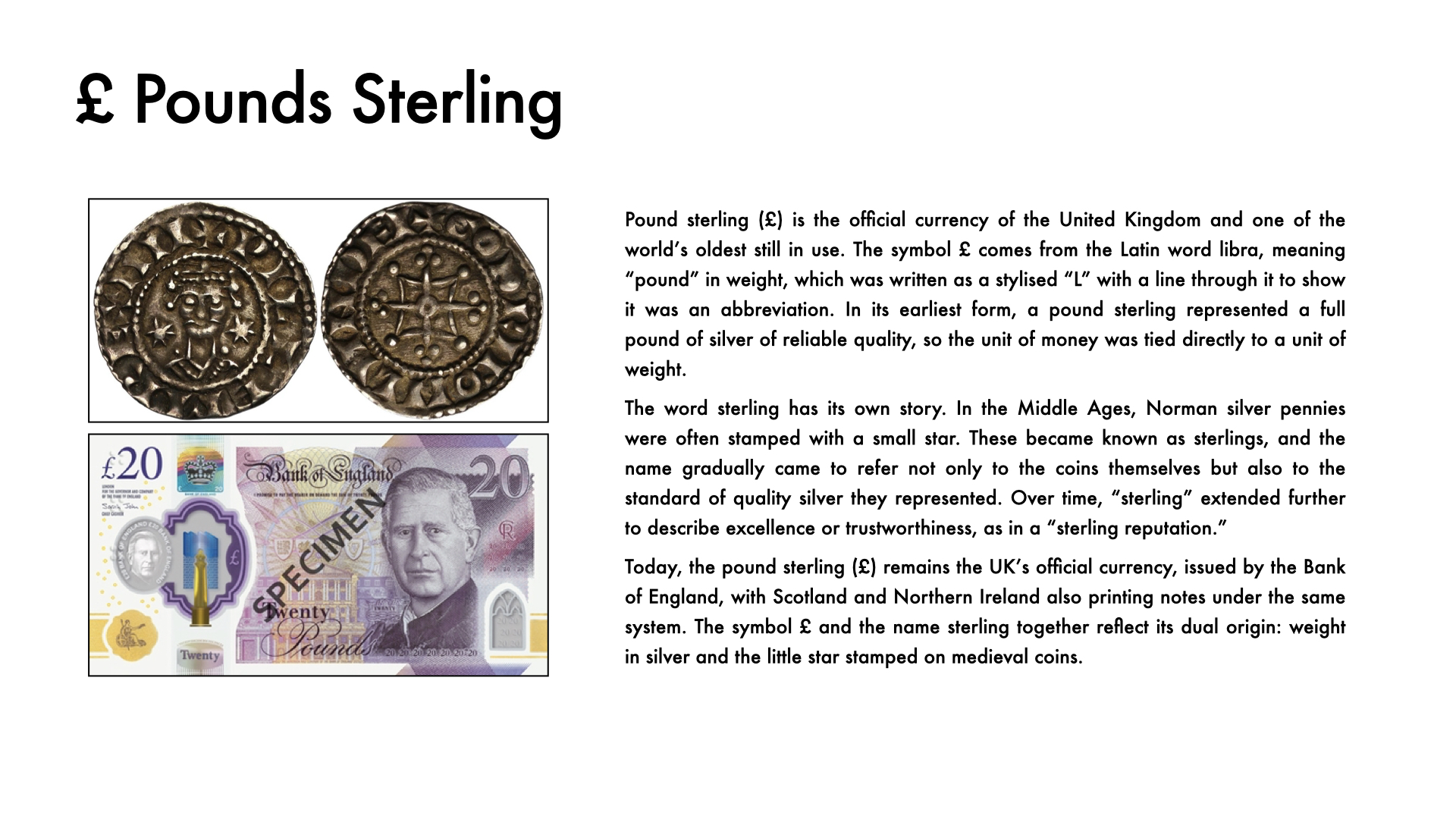
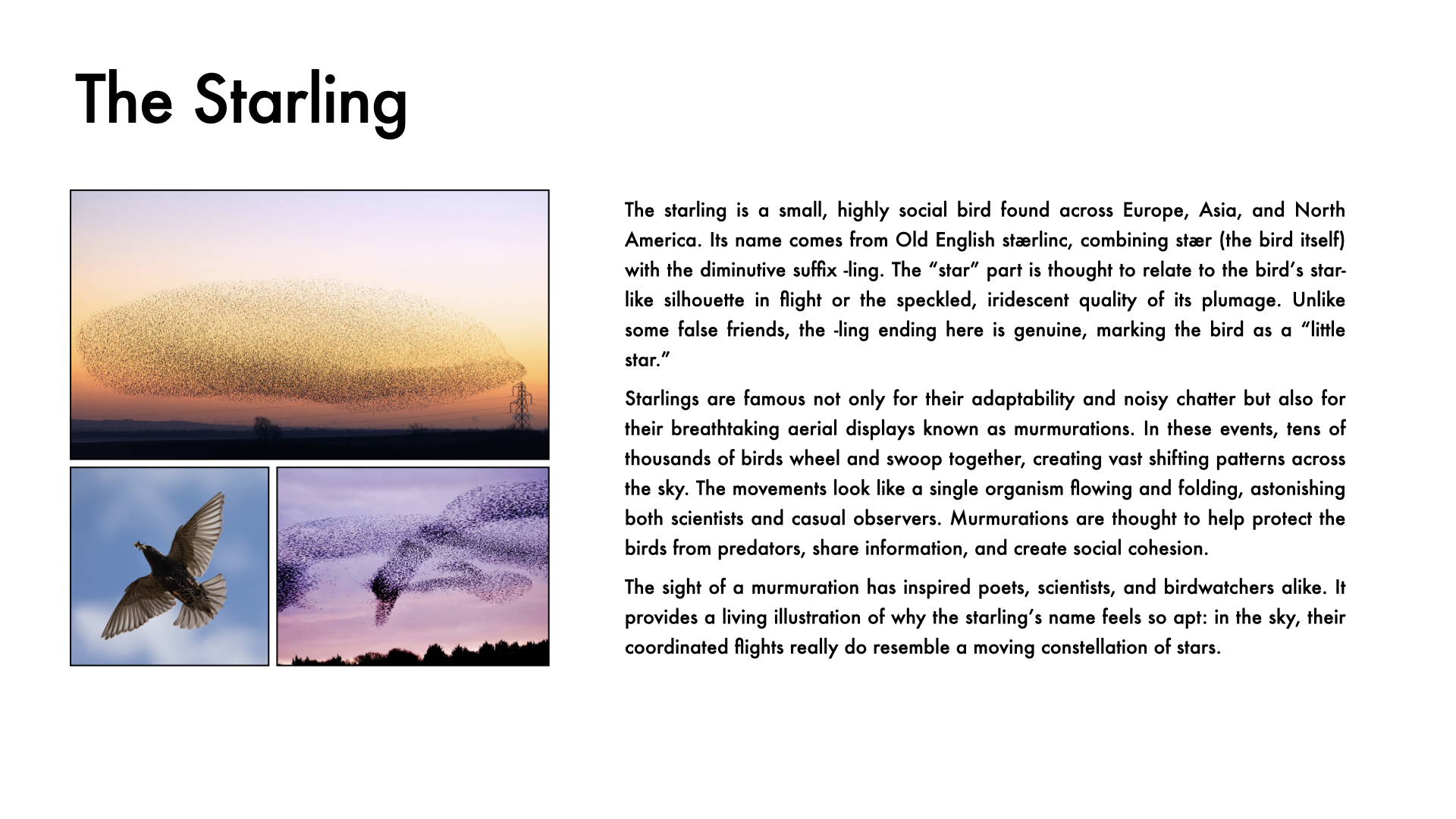
There are also a few special cases. The starling is a bird whose name comes from Old English. The name “starling” is thought to relate to a “little star,” possibly because of the bird’s star-shaped silhouette in flight or its glossy, iridescent plumage. Sterling, as in pound sterling, also contains -ling. It originally described Norman silver pennies stamped with a star — hence “little star.” Over time it came to mean silver of reliable quality, and finally the British currency.
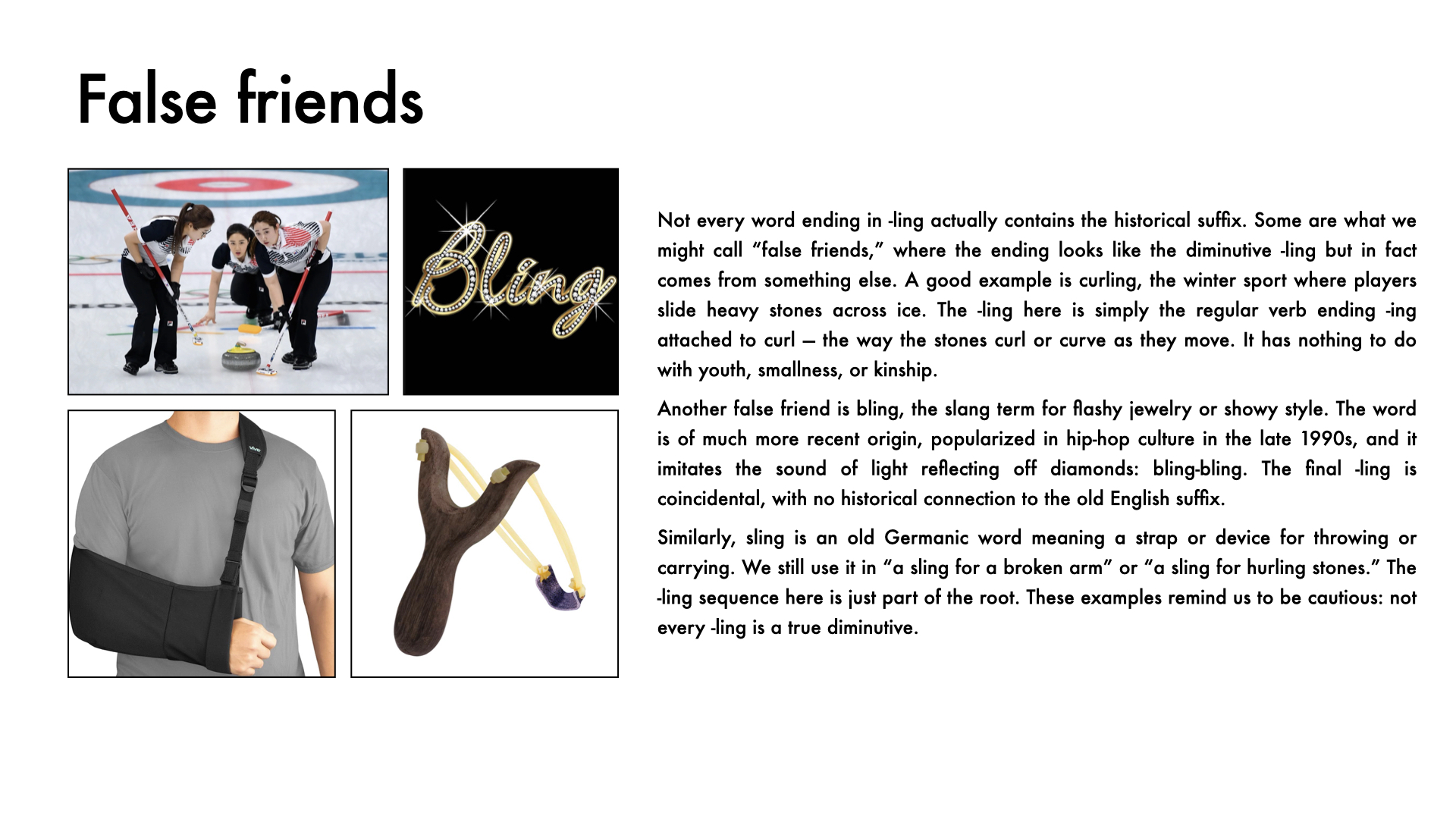
Not every word ending in -ling truly uses the suffix. Curling is the winter sport of sliding stones on ice, but the ending is just -ing from the verb to curl. Words like sling or bling are unrelated roots.
So when you encounter a word in -ling, ask: is this really the suffix, with its history of smallness, kinship, or status, or is it only a look-alike?
📽️ Slideshow
📺 Video
🔑 Key Vocabulary
- Changeling – In folklore, a fairy child secretly exchanged for a human baby.
- Darling – A beloved person; originally from “dear.”
- Duckling – A baby duck.
- Earthling – A human being, often used in science fiction by aliens to describe people from Earth.
- Fledgling – A young bird learning to fly; also used metaphorically for a beginner in any field.
- Foundling – An abandoned infant discovered and cared for by others.
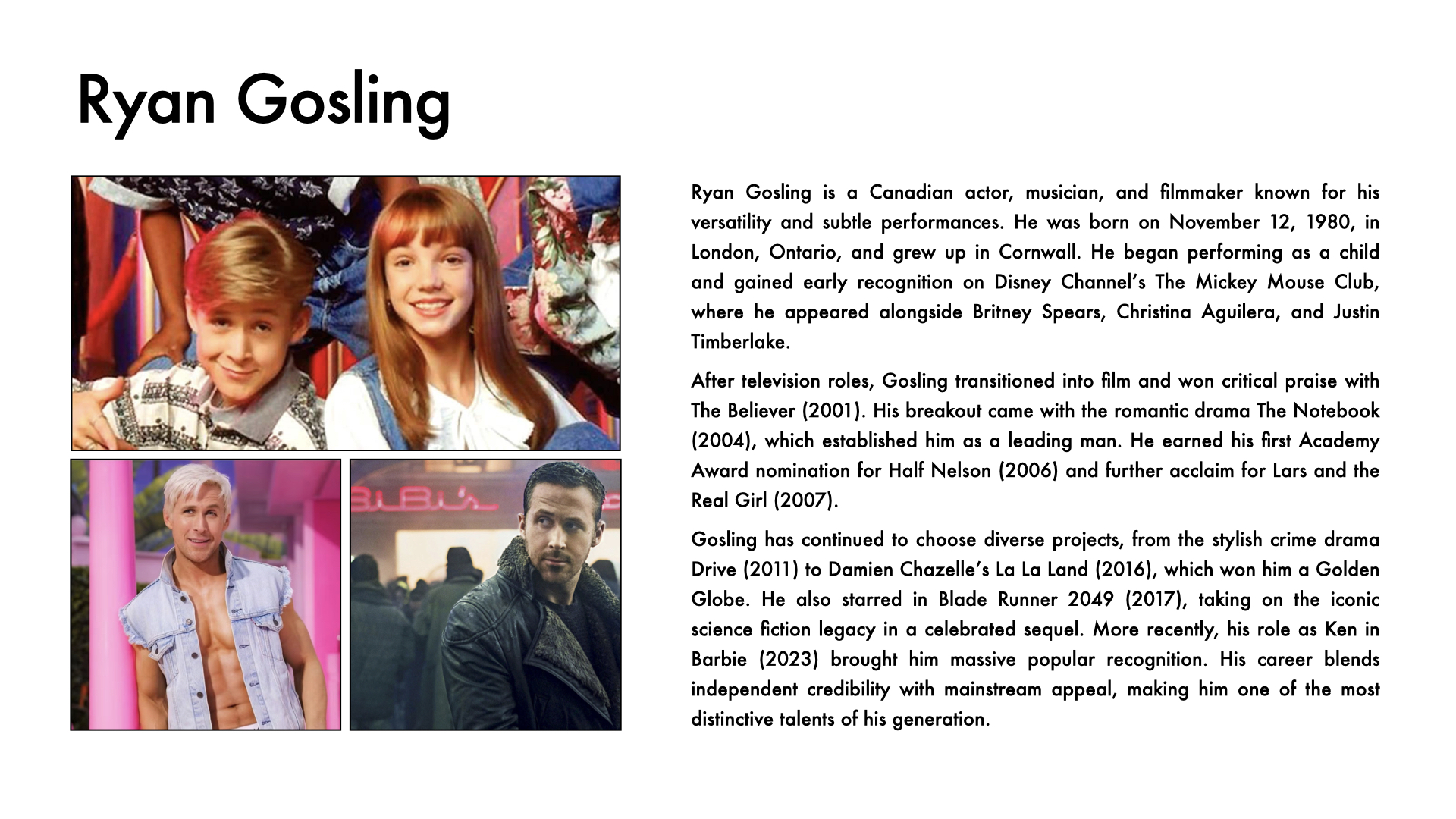
- Gosling – A baby goose; also the surname of actor Ryan Gosling.
- Hireling – A person employed for wages, often with the negative idea of lacking loyalty or higher purpose.
- Leapling – A person born on February 29 in a leap year.
- Nestling – A young bird still confined to the nest.
- Princeling – A minor prince, or by extension the privileged child of a powerful leader.
- Puffling – A baby puffin.
- Sapling – A young tree.
- Sibling – A brother or sister; a relative who shares the same parents.
- Starling – A bird, its name linked to the star-like shape of its silhouette or plumage.
- Sterling – Originally silver coins stamped with a star (“little star”), later the British currency.
- Storkling – A young stork.
- Suckling – A young mammal still nourished by its mother’s milk.
- Underling – A subordinate or inferior person, often used dismissively.
- Weakling – A frail or feeble person, usually said as an insult.
- Wildling – A fictional term popularized in Game of Thrones for outsider tribes living beyond the Wall.
- Yearling – An animal, especially a horse, that is one year old.
💬 Conversation Questions
- Which -ling word do you find the most interesting or unusual, and why?
- Do you think the word “darling” still feels affectionate today, or a little old-fashioned?
- If you were an alien in a science-fiction story, would you call humans “Earthlings” or something else?
- Have you ever seen a video of a starling murmuration? How would you describe it?
- Do you think calling someone a “weakling” or “underling” is more offensive, and why?
- In your culture, are there famous stories about foundlings (abandoned children who are later rescued)?
- What do you imagine a “Wildling” would be like in real life, outside of Game of Thrones?
- Would you rather be called a “fledgling” in a new job, or a “rookie”? Which sounds kinder?
- Do you know anyone born on February 29? How do you think leaplings feel about celebrating their birthdays?
- Why do you think so many baby animals in English use the -ling ending?
- If you could invent a new -ling word, what would it be and what would it mean?
- Does “sterling” as a word make you think more of money or of quality?
- How do you feel about words like “hireling” that reduce a job to just money?
- Do you think language shapes how we view people (for example, underlings vs. subordinates)?
- Which -ling word do you think would be funniest to use as a nickname for a friend?