Week 1️⃣ 1️⃣
Food idioms
🔊 Audio
📜 Show transcript
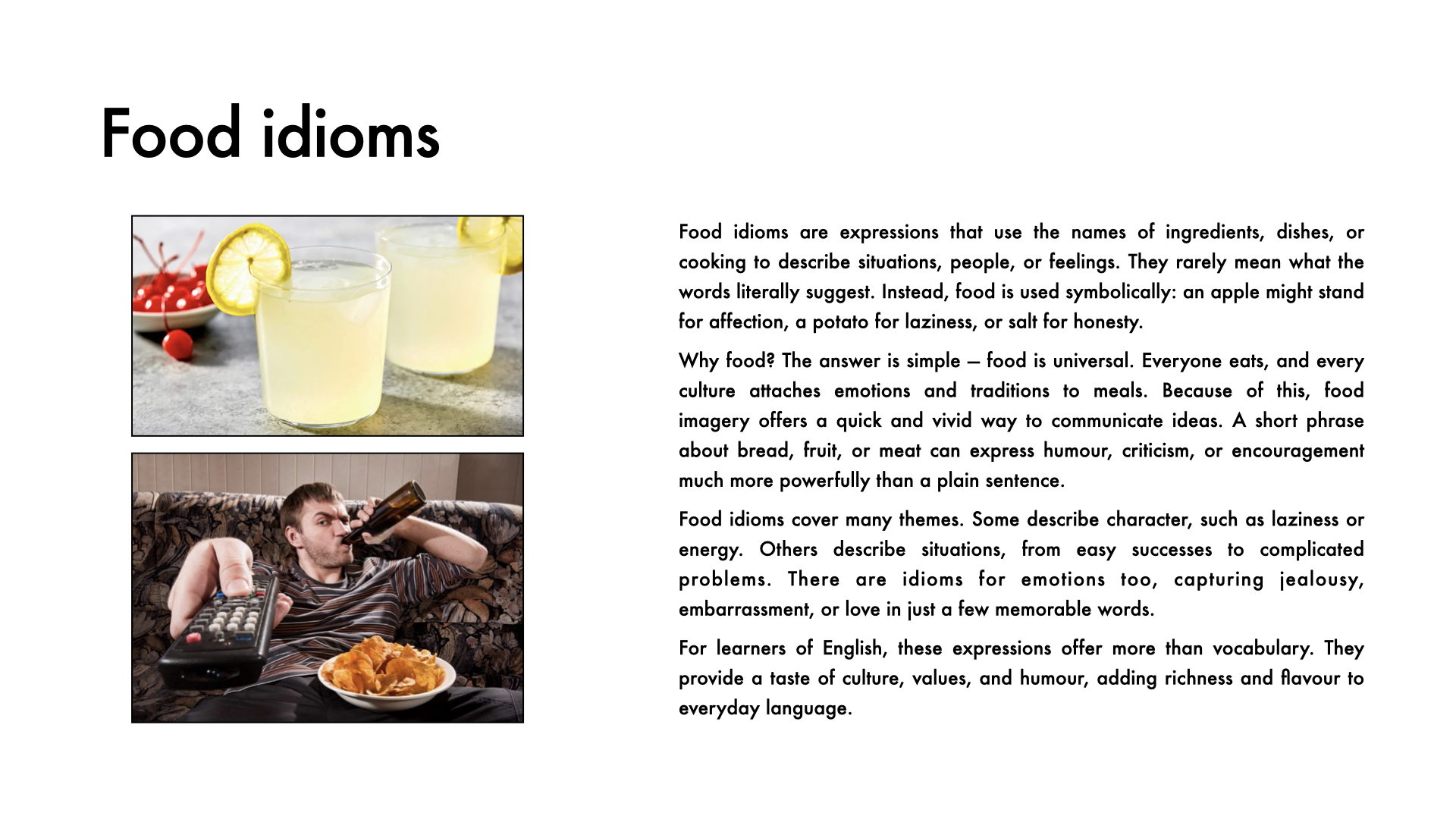
When we think of food, we usually imagine something to eat. Yet in language, food feeds our imagination in another way. In English, as in many languages, everyday expressions are flavoured with references to fruit, vegetables, meat, and even spices. These expressions, called idioms, bring colour and rhythm to ordinary speech.
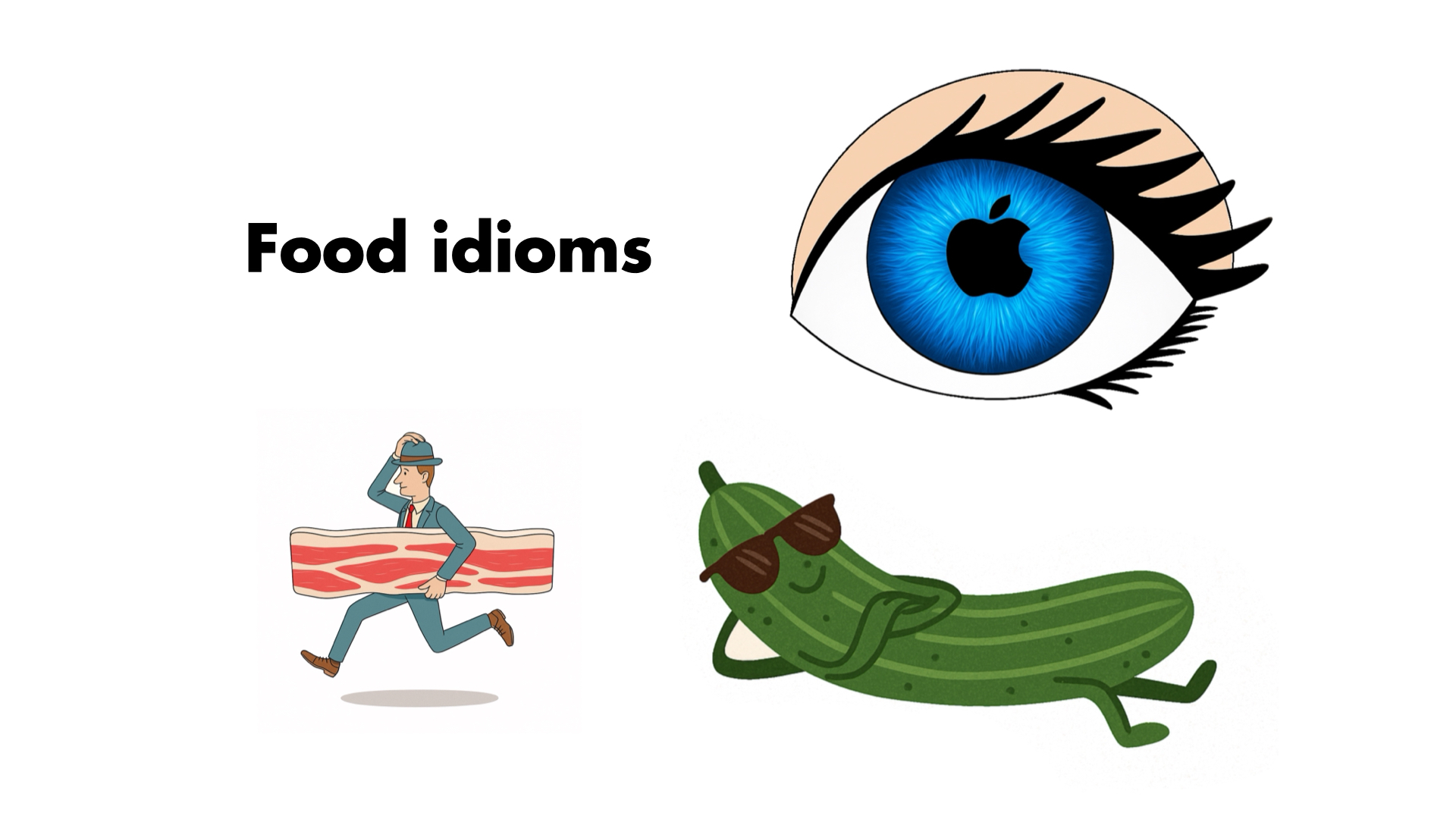
Idioms are curious because they almost never mean what they literally say. If someone describes a situation as having gone pear-shaped, no fruit is involved. The phrase simply communicates that something has gone wrong. If another person calls a loved one the apple of my eye, they are not talking about food either, but about affection. The words work as symbols, not as recipes.
Why food? One reason is that it is universal. Everyone eats, so everyone understands it. Another is that food carries powerful associations. Certain dishes mean comfort, others suggest hardship, and others imply celebration. When we use food idioms, we draw on those associations to communicate ideas quickly. A short phrase about bread or fruit can express feelings of joy, frustration, jealousy, or failure with far more impact than a plain description.
These idioms can be organised into themes. Some describe people: a lazy person may be called a couch potato, while someone energetic might be said to be full of beans. Others describe situations: an easy task might be described as a piece of cake, while a difficult issue could be a hot potato. Still others express emotions: to spill the beans is to reveal a secret, while sour grapes refers to pretending you never wanted something you failed to get.
Another reason food idioms endure is that they are playful. The images are often absurd, but this makes them memorable. Consider bring home the bacon. If translated literally, it might sound ridiculous in another language, yet in English it conveys the idea of earning a living. Learners smile at the oddity, but they also remember it.
Food idioms also appear in other languages. In Spanish, something very easy is pan comido — “eaten bread.” In German, to say das ist mir Wurst — literally “that’s sausage to me” — means “I don’t care.” These comparisons show how food imagery is both universal and cultural, shaped by each society’s tastes.
For learners of English, food idioms are more than vocabulary. They offer a window into culture, humour, and everyday thought. They season our conversations, making them richer, sharper, and more satisfying. Without them, language might be correct, but it would lack flavour.
📽️ Slideshow
📺 Video
🔑 Key Vocabulary
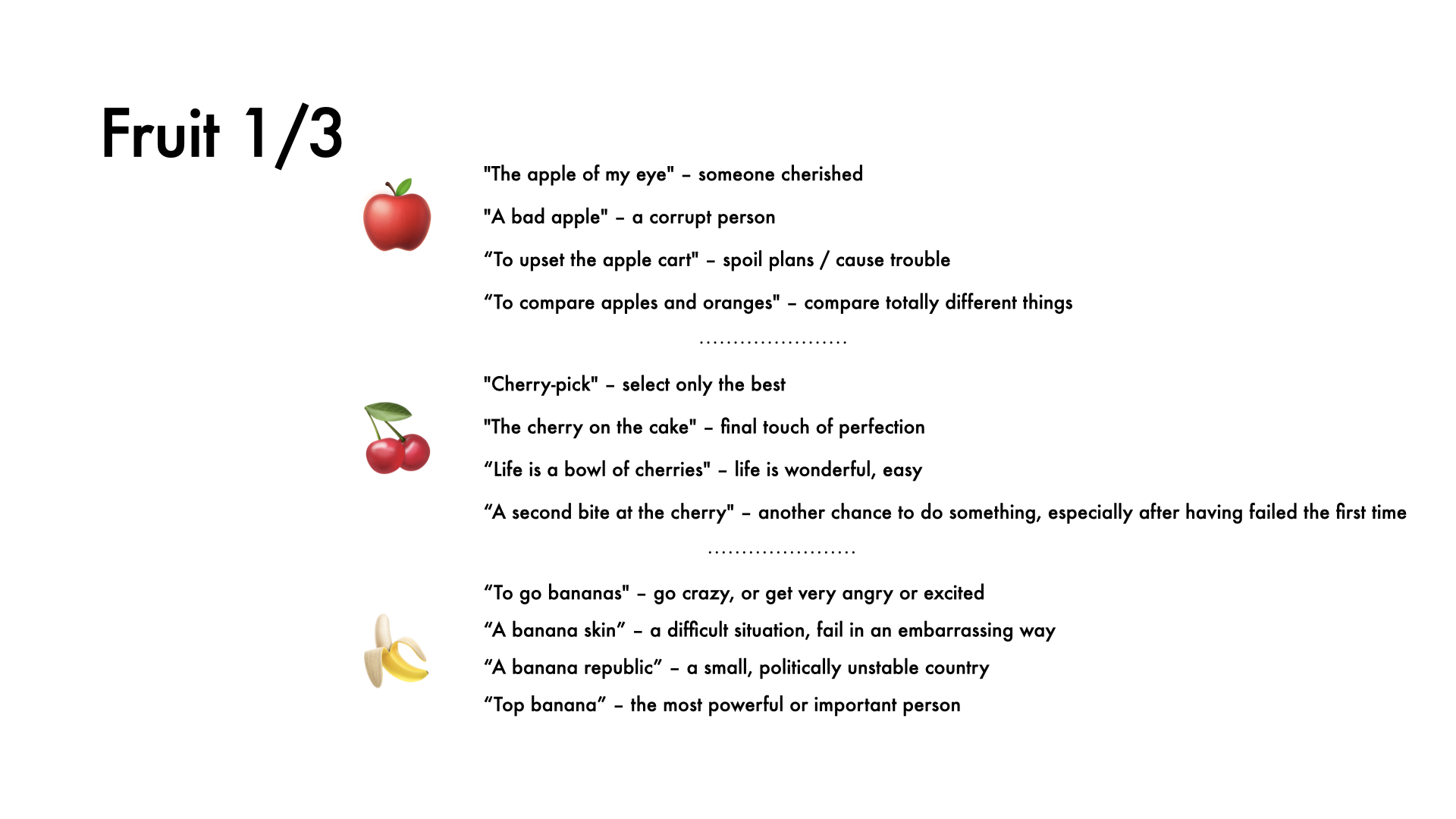
- "The apple of my eye" – someone cherished
- "A bad apple" – a corrupt person
- "To upset the apple cart" – spoil plans / cause trouble
- "To compare apples and oranges" – compare totally different things
- "Cherry-pick" – select only the best
- "The cherry on the cake" – final touch of perfection
- "Life is a bowl of cherries" – life is wonderful, easy
- "A second bite at the cherry" – another chance to do something, especially after having failed the first time
- "To go bananas" – go crazy, or get very angry or excited
- "A banana skin" – a difficult situation, fail in an embarrassing way
- "A banana republic" – a small, politically unstable country
- "Top banana" – the most powerful or important person
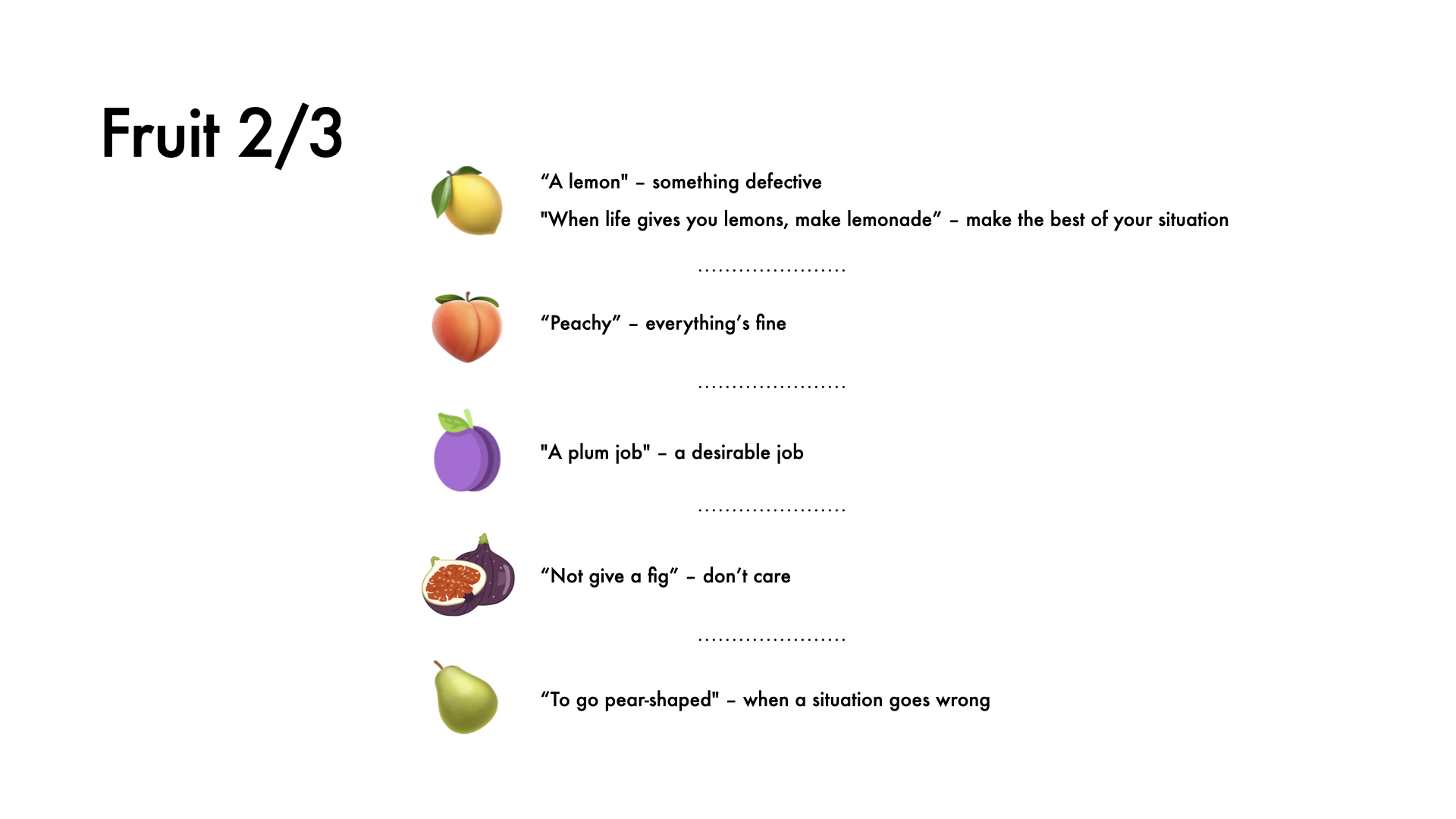
- "A lemon" – something defective
- "When life gives you lemons, make lemonade" – make the best of your situation
- "Peachy" – everything’s fine
- "A plum job" – a desirable job
- "Not give a fig" – don’t care
- "To go pear-shaped" – when a situation goes wrong
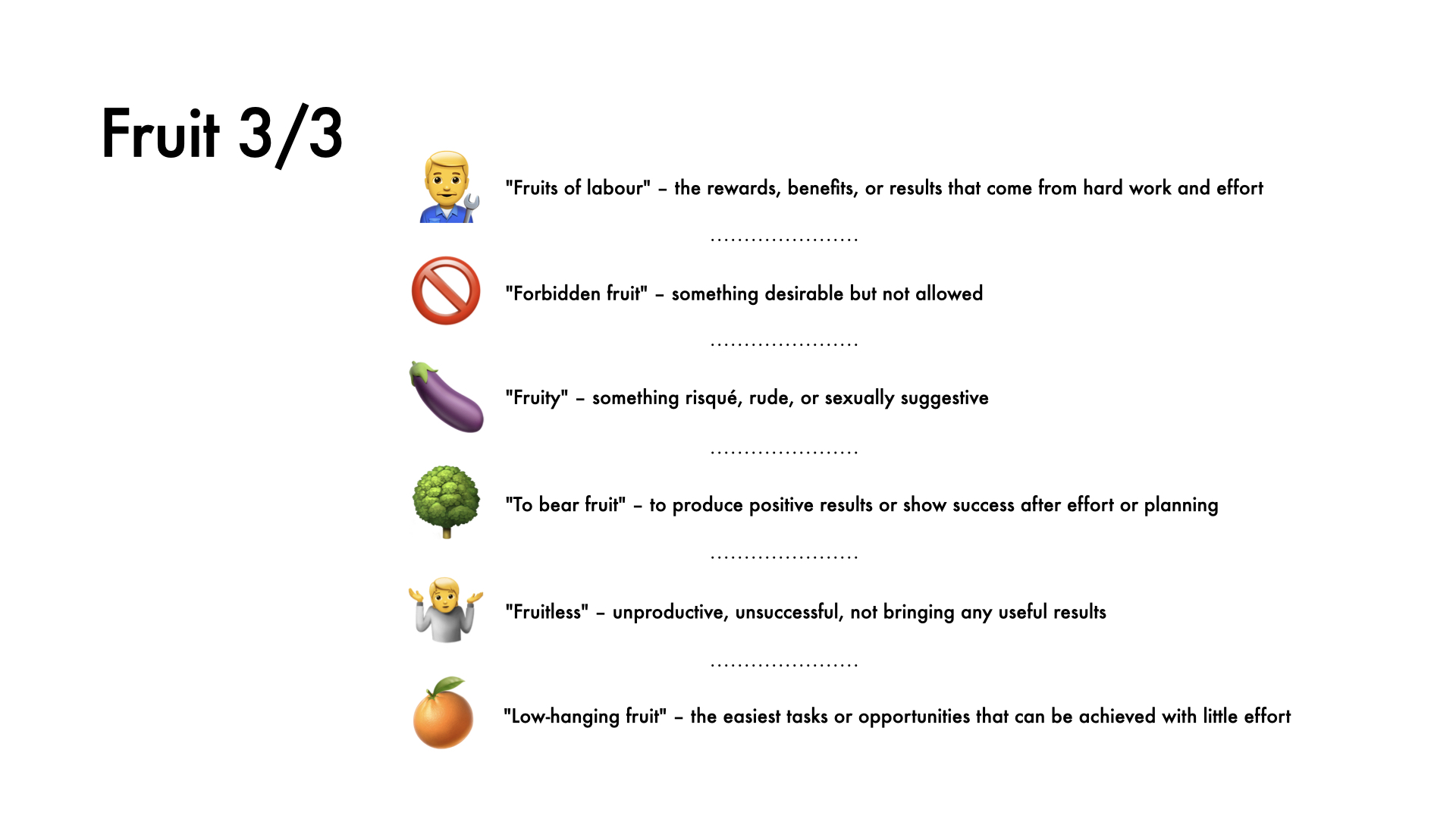
- "Fruits of labour" – the rewards, benefits, or results that come from hard work and effort
- "Forbidden fruit" – something desirable but not allowed
- "Fruity" – something risqué, rude, or sexually suggestive
- "To bear fruit" – to produce positive results or show success after effort or planning
- "Fruitless" – unproductive, unsuccessful, not bringing any useful results
- "Low-hanging fruit" – the easiest tasks or opportunities that can be achieved with little effort
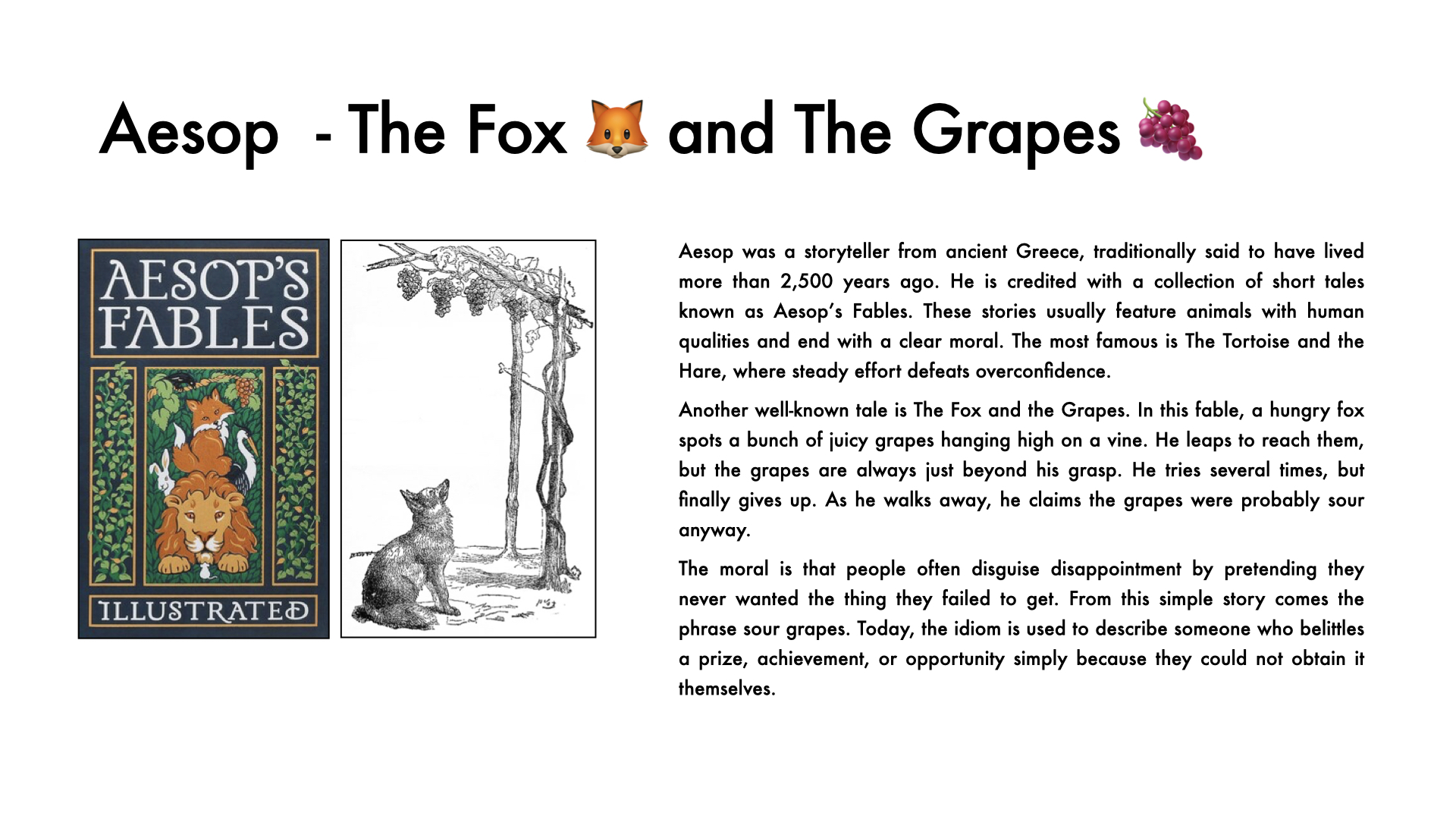
- "To have sour grapes" – someone who belittles an achievement because they could not obtain it themselves
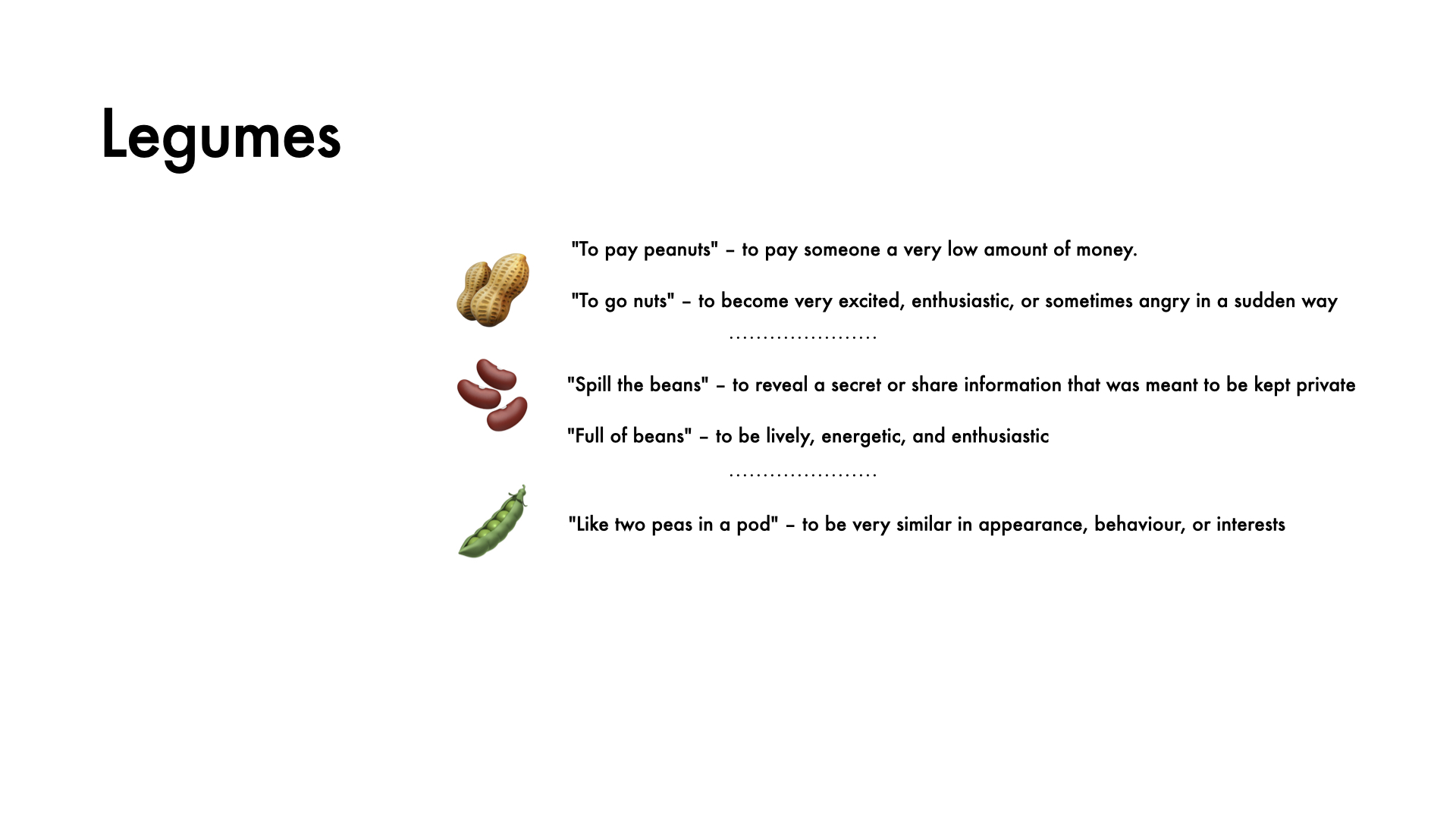
- "To go nuts" – to become very excited, enthusiastic, or sometimes angry in a sudden way
- "Spill the beans" – to reveal a secret or share information that was meant to be kept private
- "Full of beans" – to be lively, energetic, and enthusiastic
- "Like two peas in a pod" – to be very similar in appearance, behaviour, or interests
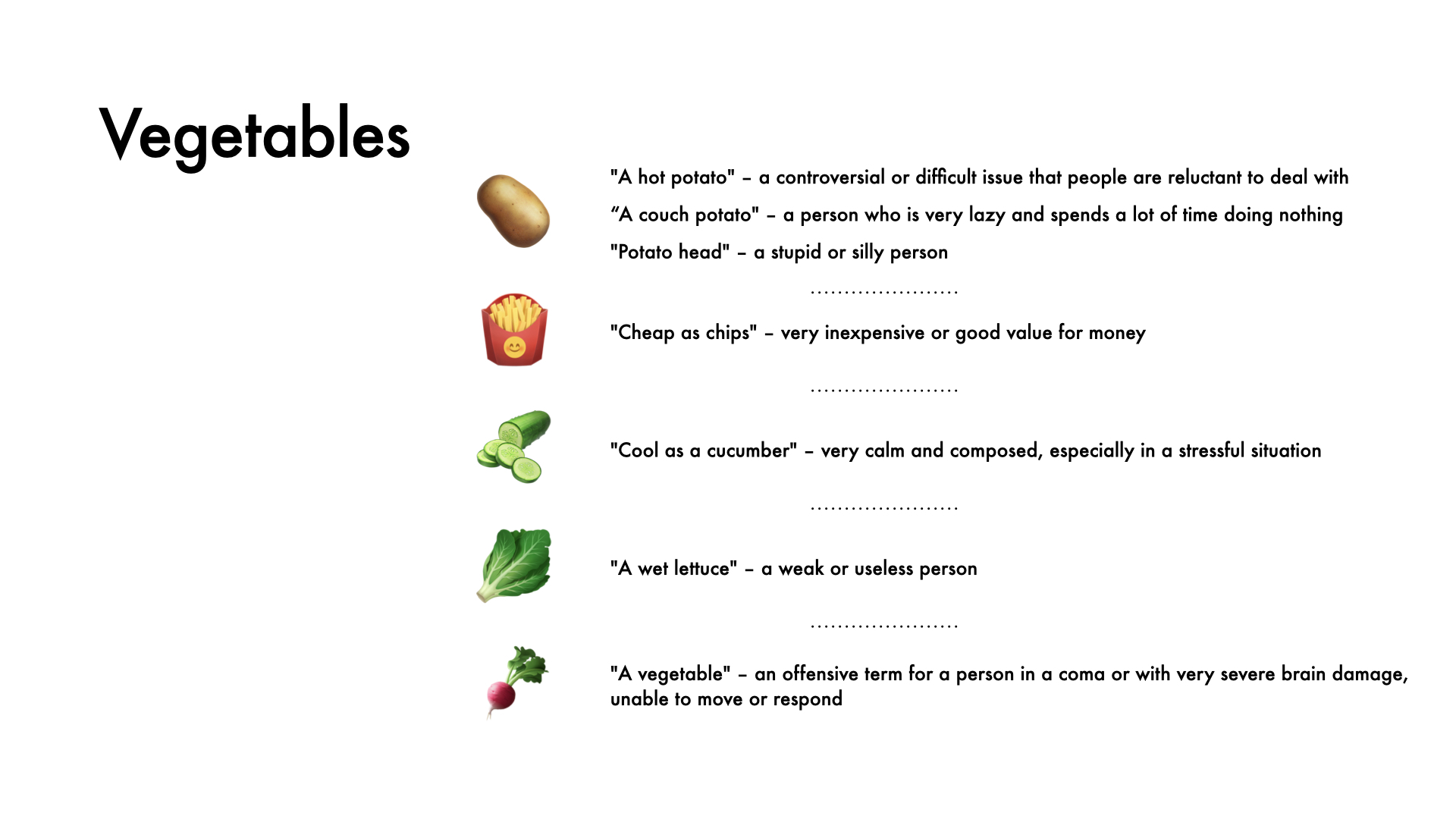
- "A hot potato" – a controversial or difficult issue that people are reluctant to deal with
- "A couch potato" – a person who is very lazy and spends a lot of time doing nothing
- "Potato head" – a stupid or silly person
- "Cheap as chips" – very inexpensive or good value for money
- "Cool as a cucumber" – very calm and composed, especially in a stressful situation
- "A wet lettuce" – a weak or useless person
- "A vegetable" – an offensive term for a person in a coma or with very severe brain damage, unable to move or respond
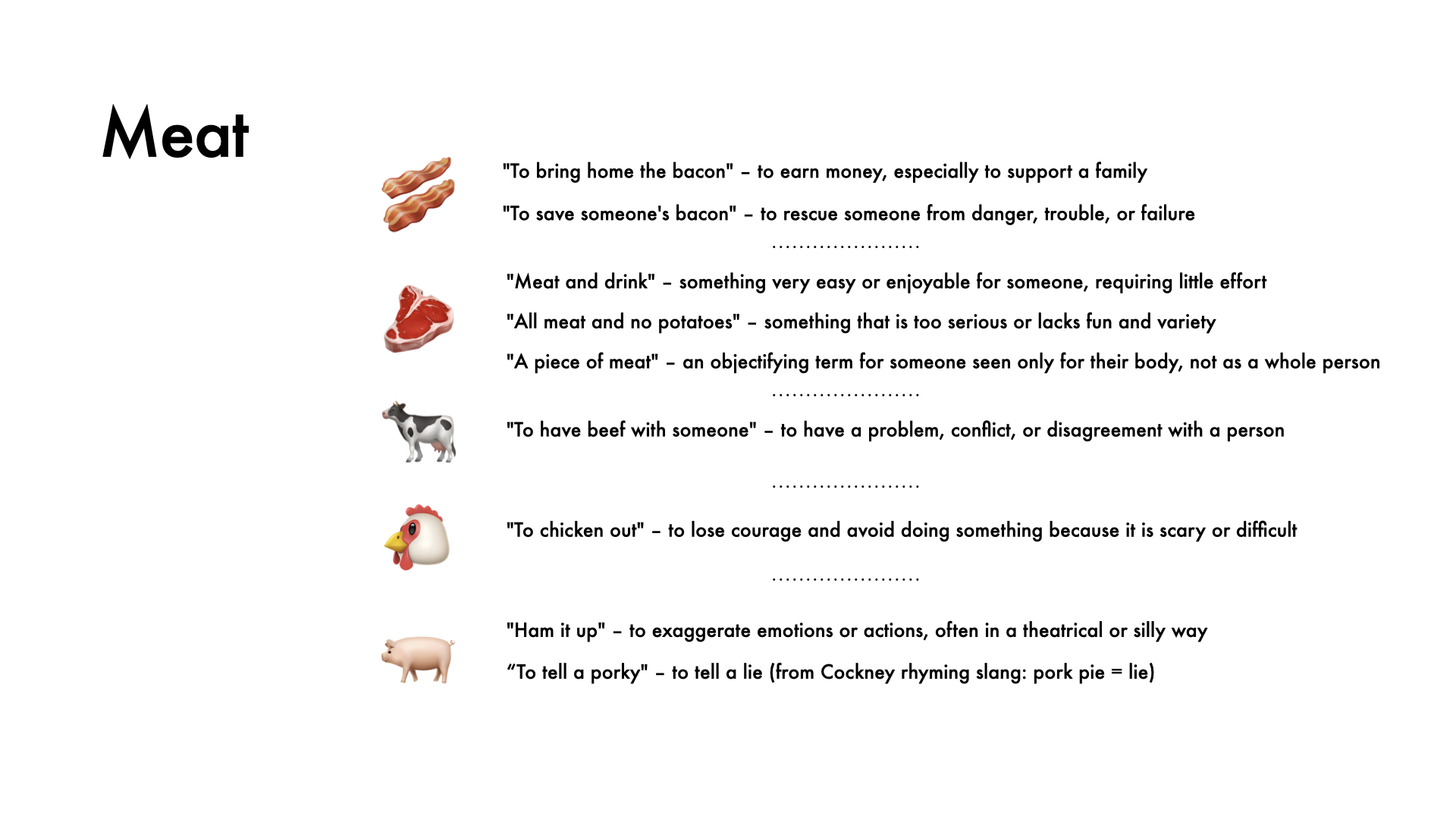
- "To bring home the bacon" – to earn money, especially to support a family
- "To save someone's bacon" – to rescue someone from danger, trouble, or failure
- "Meat and drink" – something very easy or enjoyable for someone, requiring little effort
- "All meat and no potatoes" – something that is too serious or lacks fun and variety
- "A piece of meat" – an objectifying term for someone seen only for their body, not as a whole person
- "To have beef with someone" – to have a problem, conflict, or disagreement with a person
- "To chicken out" – to lose courage and avoid doing something because it is scary or difficult
- "Ham it up" – to exaggerate emotions or actions, often in a theatrical or silly way
- "To tell a porky" – to tell a lie (from Cockney rhyming slang: pork pie = lie)
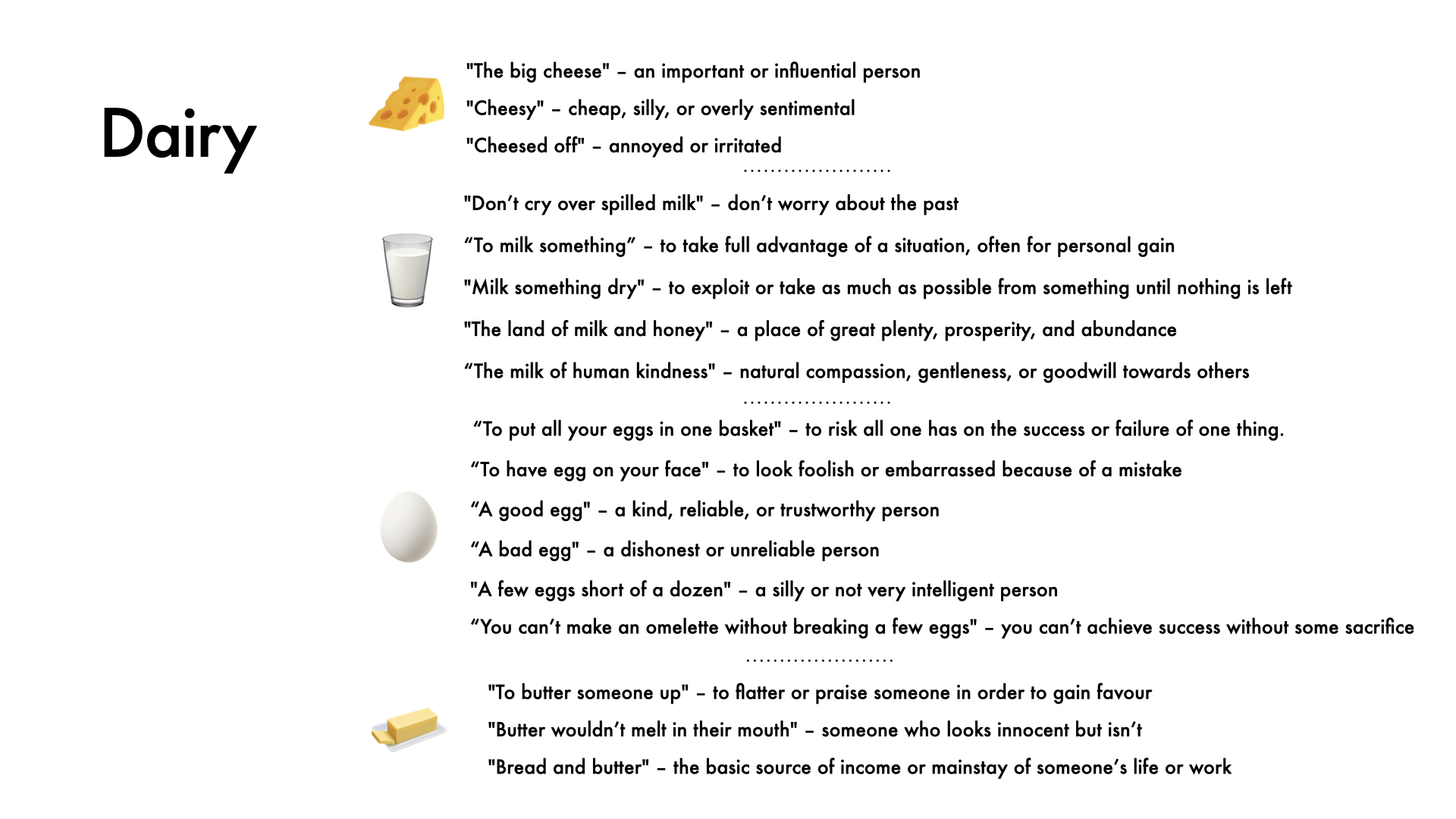
- "The big cheese" – an important or influential person
- "Cheesy" – cheap, silly, or overly sentimental
- "Cheesed off" – annoyed or irritated
- "Don’t cry over spilled milk" – don’t worry about the past
- "To milk something" – to take full advantage of a situation, often for personal gain
- "Milk something dry" – to exploit or take as much as possible from something until nothing is left
- "The land of milk and honey" – a place of great plenty, prosperity, and abundance
- "The milk of human kindness" – natural compassion, gentleness, or goodwill towards others
- "To have egg on your face" – to look foolish or embarrassed because of a mistake
- "A good egg" – a kind, reliable, or trustworthy person
- "A bad egg" – a dishonest or unreliable person
- "A few eggs short of a dozen" – a silly or not very intelligent person
- "You can’t make an omelette without breaking a few eggs" – you can’t achieve success without some sacrifice
- "To butter someone up" – to flatter or praise someone in order to gain favour
- "Butter wouldn’t melt in their mouth" – someone who looks innocent but isn’t
- "Bread and butter" – the basic source of income or mainstay of someone’s life or work
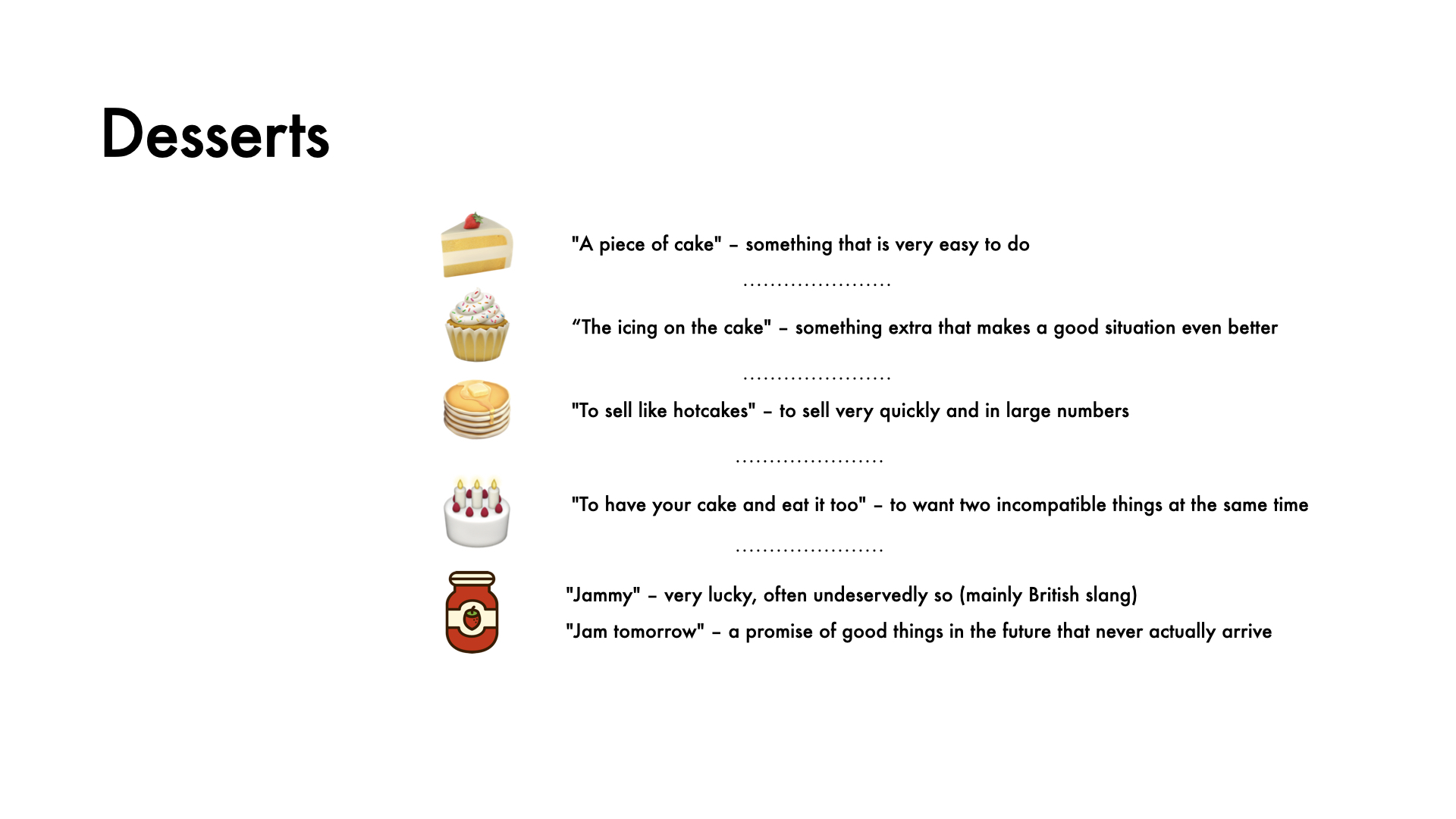
- "A piece of cake" – something that is very easy to do
- "The icing on the cake" – something extra that makes a good situation even better
- "To sell like hotcakes" – to sell very quickly and in large numbers
- "To have your cake and eat it too" – to want two incompatible things at the same time
- "Jammy" – very lucky, often undeservedly so (mainly British slang)
- "Jam tomorrow" – a promise of good things in the future that never actually arrive
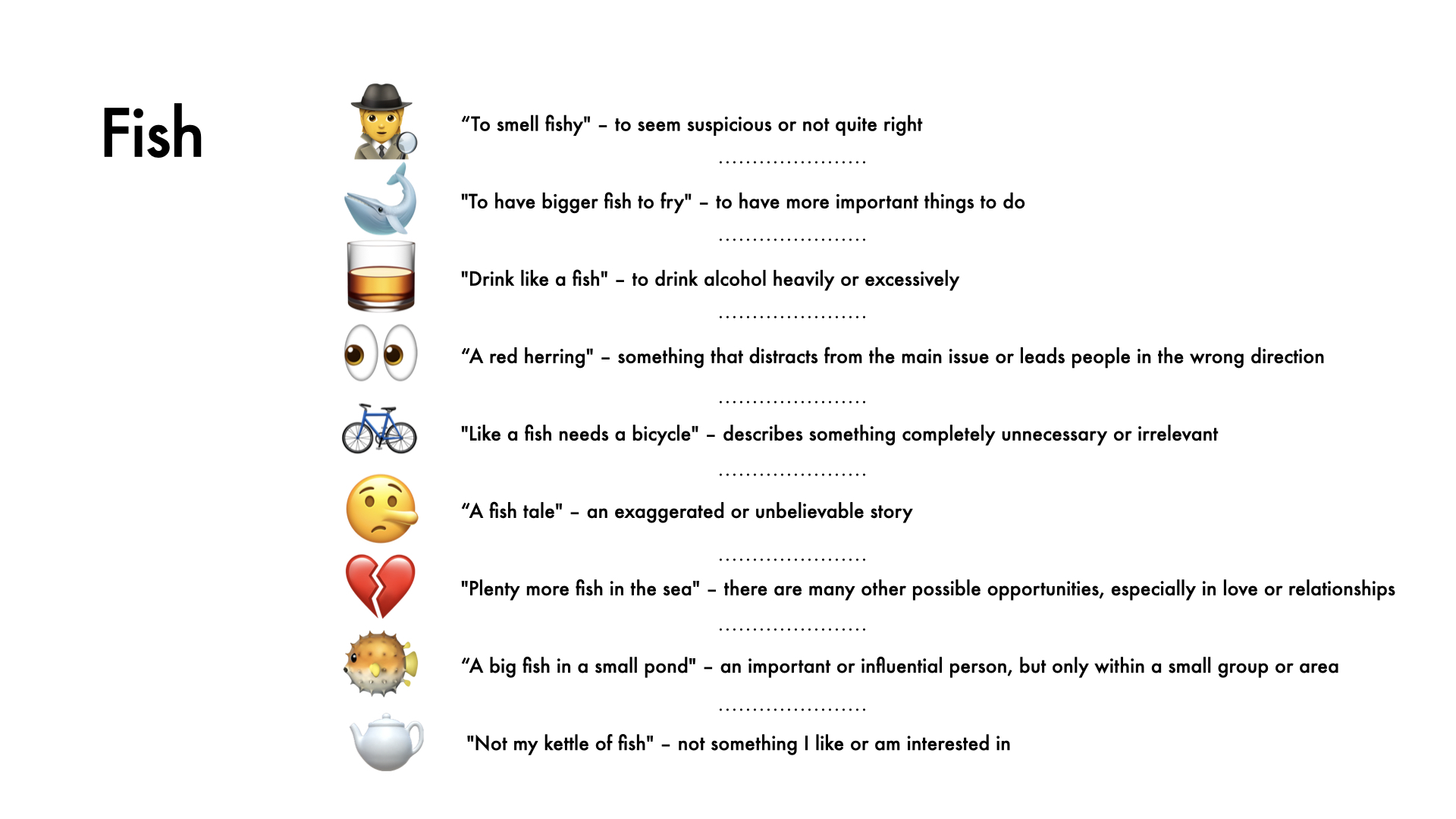
- "To smell fishy" – to seem suspicious or not quite right
- "To have bigger fish to fry" – to have more important things to do
- "Drink like a fish" – to drink alcohol heavily or excessively
- "A red herring" – something that distracts from the main issue or leads people in the wrong direction
- "Like a fish needs a bicycle" – describes something completely unnecessary or irrelevant
- "A fish tale" – an exaggerated or unbelievable story
- "Plenty more fish in the sea" – there are many other possible opportunities, especially in love or relationships
- "A big fish in a small pond" – an important or influential person, but only within a small group or area
- "Not my kettle of fish" – not something I like or am interested in
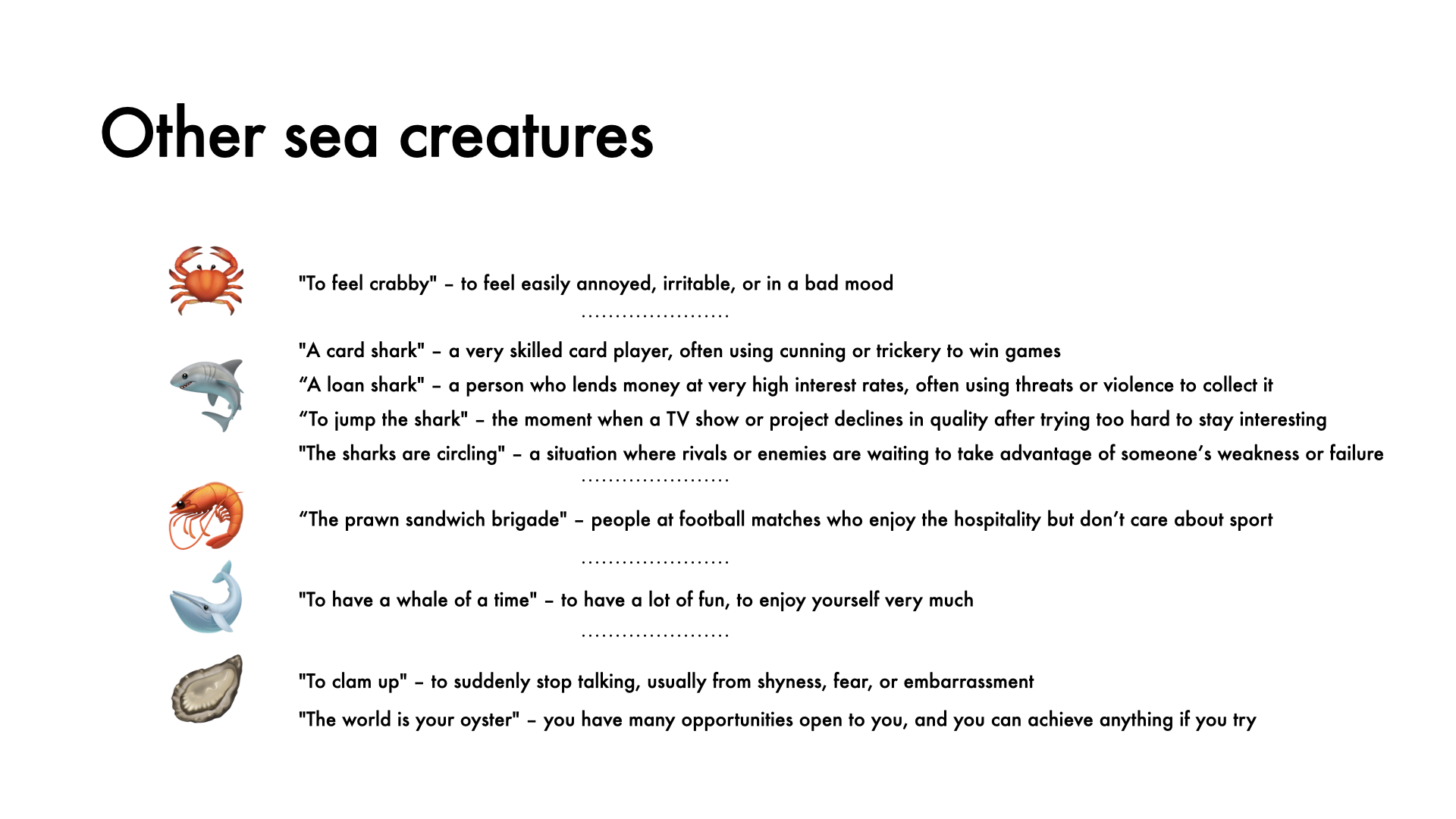
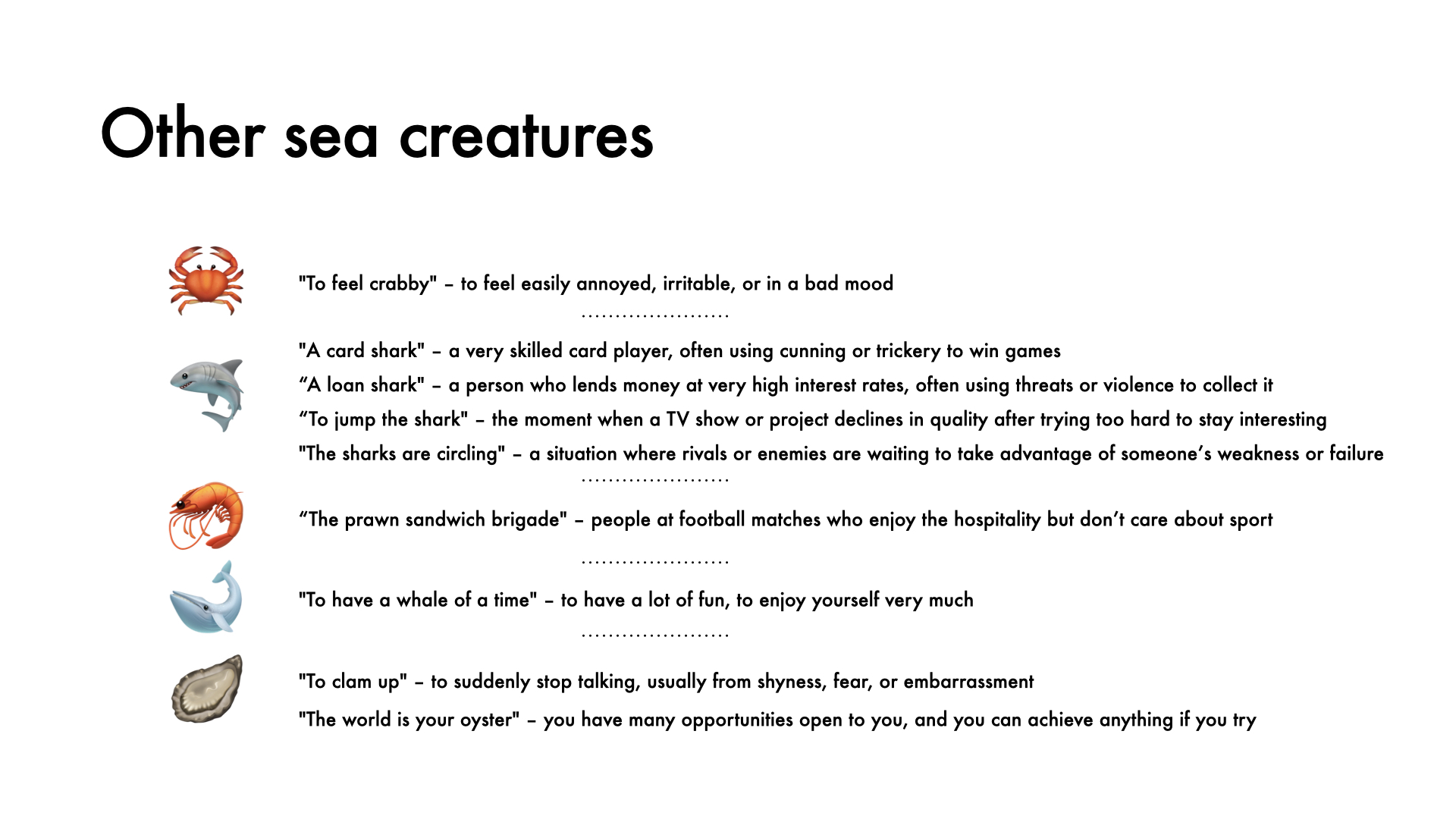
- "To feel crabby" – to feel easily annoyed, irritable, or in a bad mood
- "A card shark" – a very skilled card player, often using cunning or trickery to win games
- "A loan shark" – a person who lends money at very high interest rates, often using threats or violence to collect it
- "To jump the shark" – the moment when a TV show or project declines in quality after trying too hard to stay interesting
- "The sharks are circling" – a situation where rivals or enemies are waiting to take advantage of someone’s weakness or failure
- "The prawn sandwich brigade" – people at football matches who enjoy the hospitality but don’t care about sport
- "To have a whale of a time" – to have a lot of fun, to enjoy yourself very much
- "To clam up" – to suddenly stop talking, usually from shyness, fear, or embarrassment
- "The world is your oyster" – you have many opportunities open to you, and you can achieve anything if you try
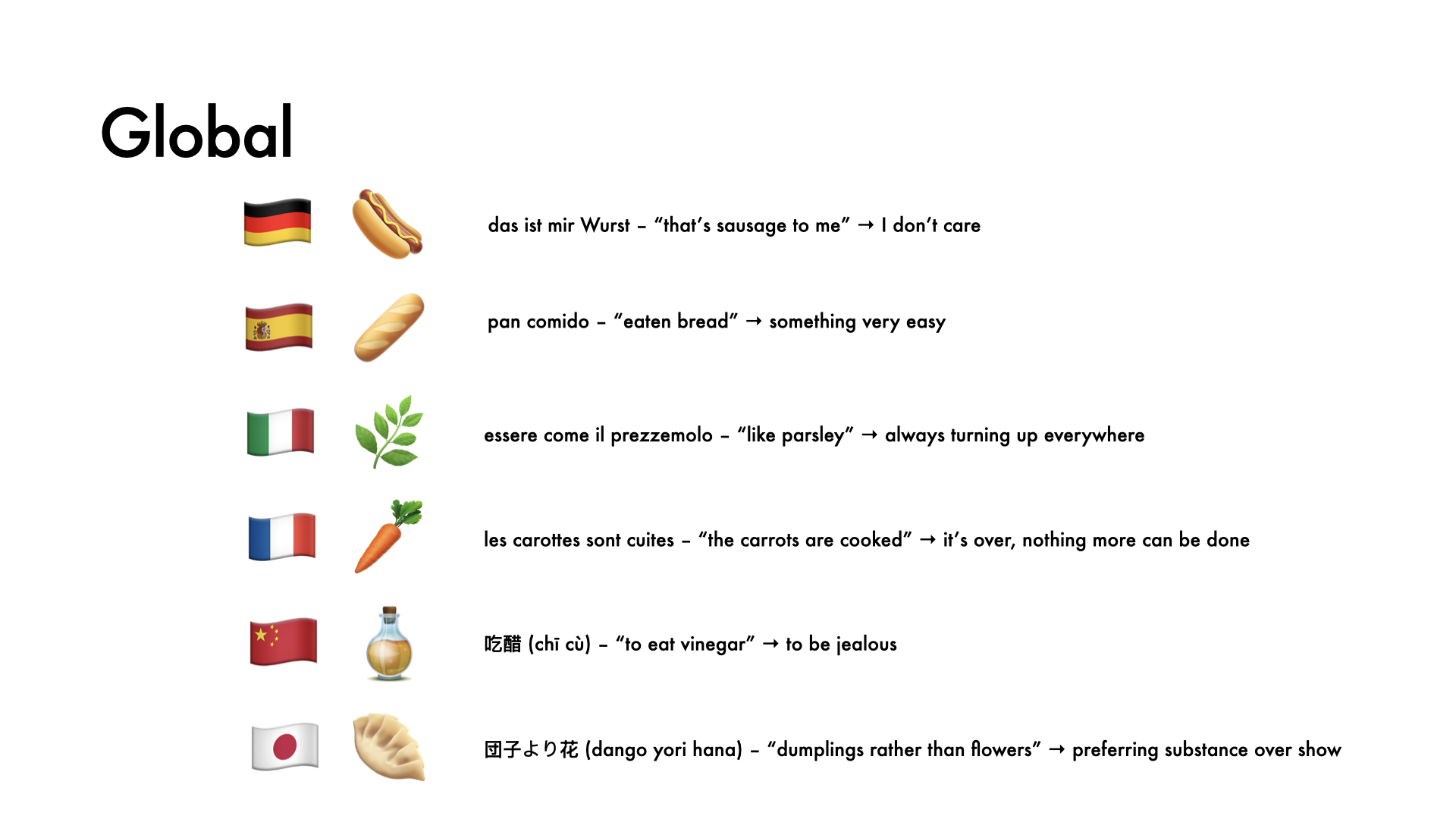
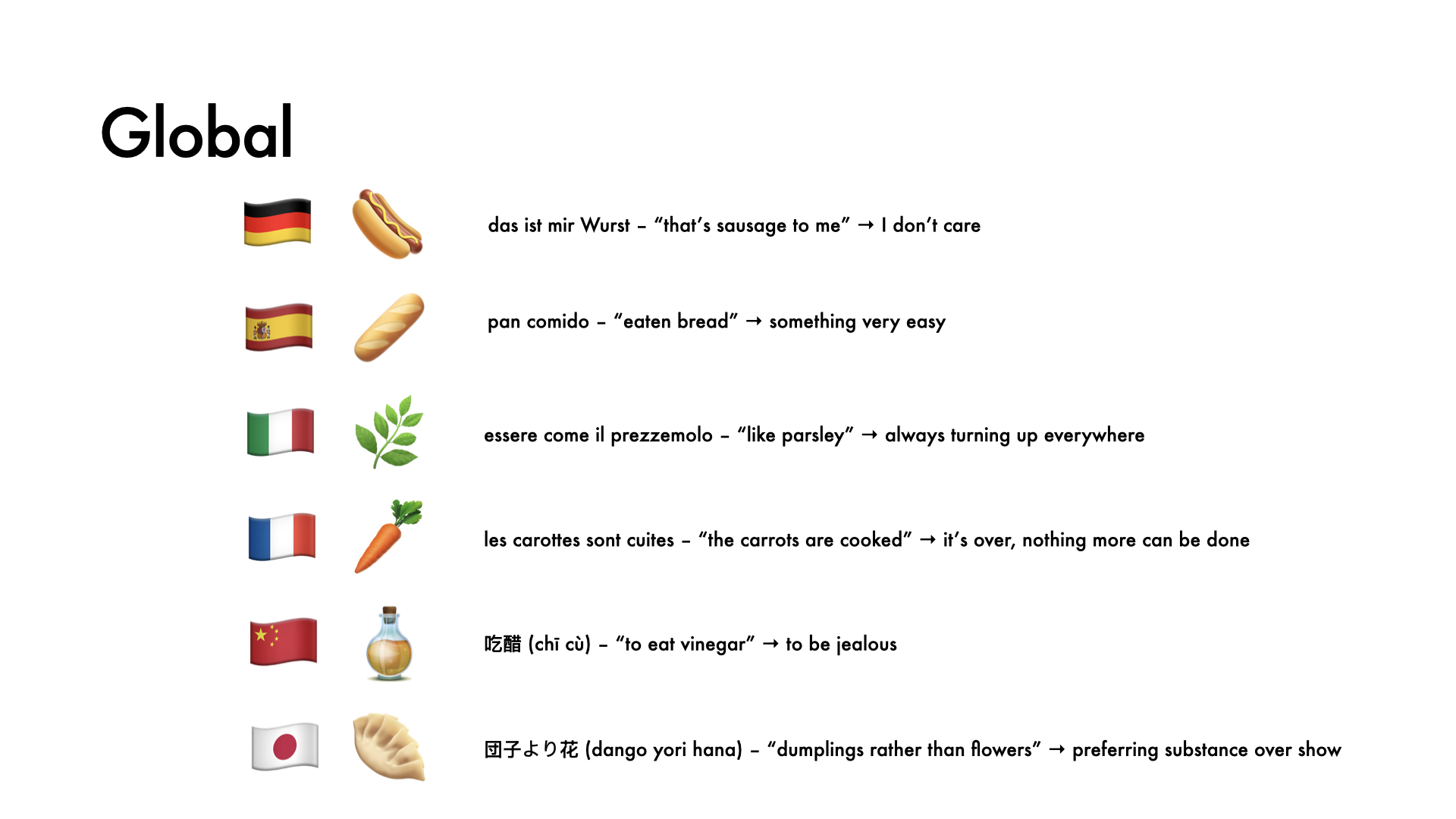
- Spanish: "pan comido" – “eaten bread” → something very easy
- German: "das ist mir Wurst" – “that’s sausage to me” → I don’t care
- Italian: "essere come il prezzemolo" – “like parsley” → always turning up everywhere
- French: "les carottes sont cuites" – “the carrots are cooked” → it’s over, nothing more can be done
- Chinese: "吃醋 (chī cù)" – “to eat vinegar” → to be jealous
- Japanese: "団子より花 (dango yori hana)" – “dumplings rather than flowers” → preferring substance over show
Fruit
Legumes
Vegetables
Meat
Dairy & Bakery
Fish
Other Sea Creatures
Around the World
💬 Conversation Questions
- Who is the "apple of your eye" at the moment, and why?
- Can you describe a time in your life when everything "went pear-shaped"?
- Have you ever seen someone try to "cherry-pick" the best parts of a situation?
- When was the last time you felt "full of beans"?
- Do you know anyone who is a bit of a "couch potato"? Is it always a bad thing?
- What issue in the news right now feels like a real "hot potato"?
- Have you ever bought something that turned out to be "a lemon"? What happened?
- Do you think exams today are "a piece of cake" compared to the past?
- When did you last "butter someone up" to get what you wanted?
- Have you ever "chickened out" of doing something scary? What was it?
- Do you know anyone who drinks "like a fish"? How does it affect their life?
- What’s a situation where you’ve had to "save someone’s bacon" — or they saved yours?
- Do you believe there are always "plenty more fish in the sea" after a breakup?
- Have you ever had "sour grapes" about something you couldn’t achieve?
- What’s been the "icing on the cake" in your life recently?